How to Get to Meteora: Train from Athens, Tours and Where to Stay
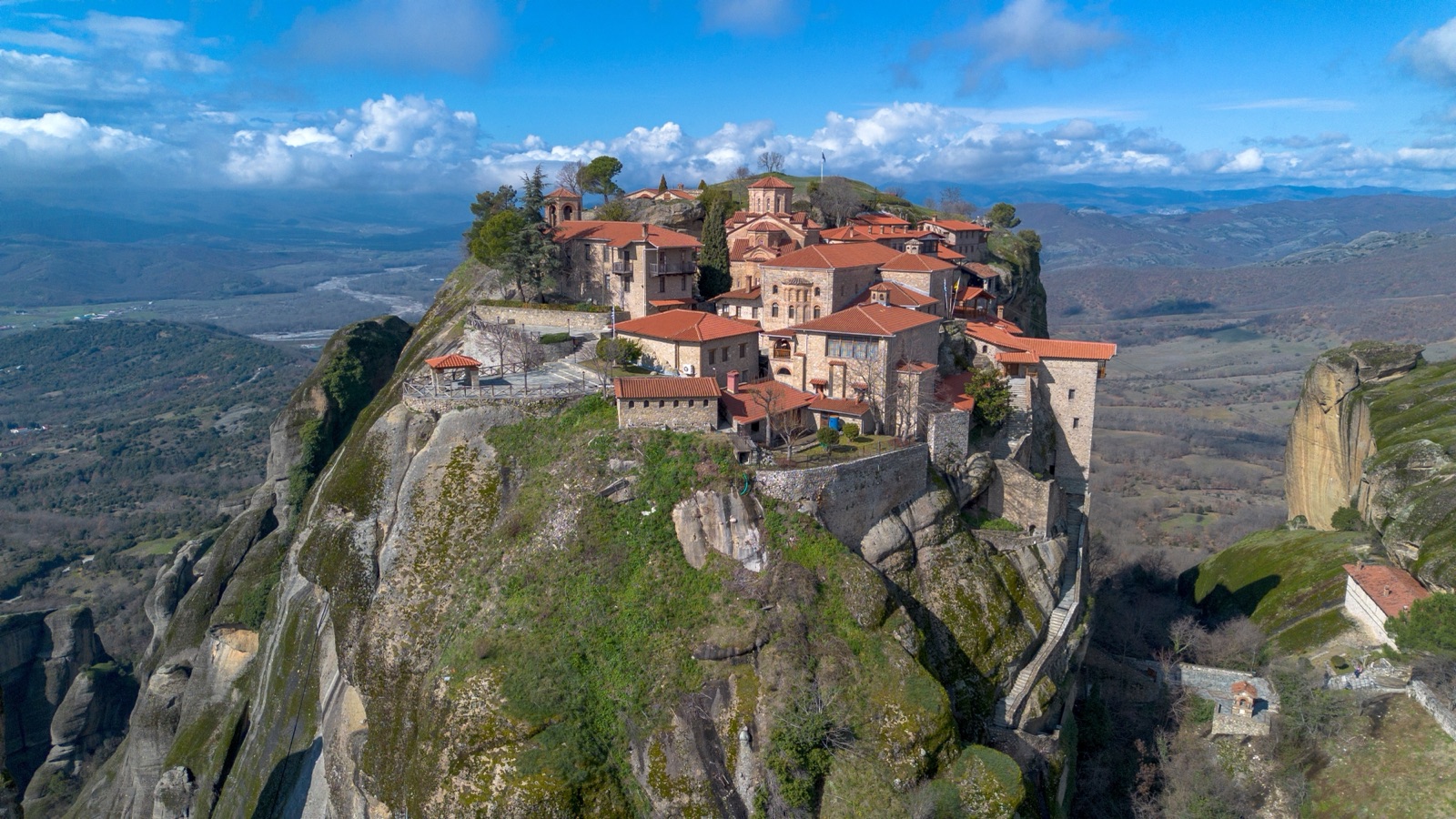
Meteora is one of the most extraordinary sights in Greece: monasteries perched on top of towering rock pillars rising out of the plain of Thessaly. It is also a long way from anywhere most visitors start. There is no airport nearby, and from Athens it is a journey of several hours each way. The question is not whether to go, but how — and whether to do it in a day or stay overnight.
This guide covers the train from Athens, the bus tours from Athens and Thessaloniki, the two-day options, and where to stay if you do not want to rush.
Where Meteora is
The monasteries stand above the town of Kalambaka and the village of Kastraki, in central Greece. Kalambaka is the base: it has the railway station, most of the hotels and the roads up to the monasteries. Kastraki, just beyond it, sits right at the foot of the rocks.
What you are travelling to
It is worth knowing what makes Meteora special before you commit to the journey.
The monasteries stand on the summits of huge rock pillars, some of them rising sheer from the valley floor. Most of the surviving monasteries were founded in the 14th to 16th centuries, and at one time 24 monasteries were active here. Today six historic monasteries remain active and open to visitors — four for men and two for women — and together they have been a UNESCO World Heritage Site since 1988.
For centuries, the only way up was by removable ladders or hoisting ropes. Steps were carved into the rock in the 1920s, which is why you can visit them today by climbing stairways rather than being hauled up in a net. Standing at the foot of the rocks and looking up, it is hard to believe that anyone built anything there at all.
By train from Athens
The train is the classic independent way to reach Meteora, and it drops you in Kalambaka, the town at the foot of the rocks.
The express trains
- Outbound: the express train 884 leaves Athens at 07:20 and reaches Kalambaka at 11:31.
- Return: the express train 885 leaves Kalambaka at 17:15 and arrives in Athens at 21:25.
Timetables change, so check the current times with the rail operator before you travel.
Direct trains and connections
Some trains to Meteora are not direct and require a connection at Palaiofarsalos. Kalambaka is the end of the line, so if you are on a direct train you cannot miss your stop.
From the station
The station is well placed. Most accommodation in Kalambaka is 5–15 minutes on foot from the station; if you are staying in Kastraki, a 5–10 minute taxi ride is recommended.
Is a day trip by train realistic?
Just about. With the express arriving at 11:31 and the return leaving at 17:15, you have most of an afternoon in Meteora — enough for a guided tour of several monasteries if you have booked one to meet the train. It is a long day, and you will see much more if you stay the night.
Day trips from Athens
If you would rather have everything organised, several day trips from Athens handle the whole journey.
Day trip from Athens by bus. A 9am departure from Athens with stops by the sea, a four-hour guided tour with three monasteries visited inside, the hermit caves and lunch, in about 14 hours. The guide does not go inside the monasteries with you, but you see all six from the viewpoints.
Day trip from Athens by train. Train from Athens, then a guided tour of the monasteries and the hermit caves, in about 14 hours. The train is more comfortable than a long coach ride, and the guided tour meets you at Kalambaka.
Both are long days. They are the right choice if you have only one day for Meteora and do not want to plan transport; if you can spare a night, the two-day tours or an overnight stay are far more relaxed.
Day trips from Thessaloniki
From Thessaloniki, Meteora is closer. The day trip from Thessaloniki by bus takes about 11 hours, with visits to two of the six monasteries and a lunch stop in Kastraki. It is a good option for visitors based in northern Greece.
Two days from Athens
The most relaxed way to see Meteora from Athens is to stay a night.
The two-day tour from Athens includes two guided tours, one of them a sunset tour, the monasteries and hidden caves, and a night in a hotel. Splitting the visit over two days means you see Meteora in both evening and morning light, and you are not racing a train or a coach back to Athens.
Staying overnight: Kalambaka or Kastraki?
If you organise your own trip, staying at least one night is the single best decision you can make.
Kalambaka is the town at the foot of the rocks. It has the railway station, most of the hotels and restaurants, and it is the practical base if you arrive by train: most accommodation is 5 to 15 minutes’ walk from the station.
Kastraki is a village right beneath the rock pillars, a short taxi ride — 5 to 10 minutes — from the station. It is quieter and closer to the rocks, and waking up beneath them is a memorable experience.
Either works. Choose Kalambaka for convenience, Kastraki for atmosphere.
Train, bus tour or overnight: the trade-offs
It helps to lay the three main approaches side by side.
The train on your own is the most independent option. You choose your monasteries and your pace, and the express trains are comfortable. The trade-off is that the day is bounded by the timetable — 11:31 arrival, 17:15 departure — and you must organise transport between the monasteries yourself.
A guided day trip removes the planning. From Athens, the bus trip leaves at 9am and includes three monasteries inside, the hermit caves and lunch; the train-based trip adds comfort on the long journey. The trade-off is a 14-hour day and a fixed itinerary.
Staying overnight gives you Meteora at its best: sunset on the rocks, a quiet early morning, and time to visit monasteries on different days. The trade-off is simply the extra night, and it is almost always worth it.
Local tours once you are there
Once you are in Kalambaka or Kastraki, two popular local tours make the most of your time, both with pickup from your hotel in Kalambaka or Kastraki:
The sunset tour. About 4 hours: every monastery seen from the viewpoints, the inside of one of them, the hermit caves and sunset over the rocks.
The morning tour. About 4 hours: all six monasteries seen and three visited inside, with a guide plus audio guides.
Doing one of each — sunset on the evening you arrive, the morning tour the next day — is one of the best ways to experience Meteora.
Planning around the monasteries’ hours
Whichever way you arrive, remember that each monastery closes on its own weekday, and hours are shorter in winter. Every Saturday and Sunday, all six monasteries are open. Our guide to monastery hours, fees and the dress code has the full timetable.
Getting around once you are there
The monasteries are spread across the rock landscape above Kalambaka and Kastraki, and you need a plan for getting between them.
- A local tour is the easiest: the sunset and morning tours both include pickup from your hotel in Kalambaka or Kastraki and take you between the viewpoints and the monasteries.
- A taxi works well for visiting a monastery or two on your own, especially from Kastraki.
- On foot, walking paths link Kastraki and Kalambaka with the rocks and some of the monasteries; they are best for fit walkers with a map and plenty of water.
- A hire car gives the most freedom if you are touring the region.
When to go
Meteora can be visited all year, but the monasteries’ timetable shapes your plans.
- Summer hours apply from 1 April to 31 October, with longer opening times.
- Winter hours apply from 1 November to 31 March, with shorter hours and, at some monasteries, more closing days.
- Every Saturday and Sunday, all six monasteries are open, which makes weekends a good choice in winter in particular.
- Each monastery closes on its own weekday the rest of the time, so check which ones are open on the day you plan to visit.
Budgeting for the day
The main costs beyond your transport are simple:
- Admission is €5 per monastery, paid at each entrance, in cash. Visiting three monasteries costs €15 per person.
- Tours vary: the local sunset and morning tours are half-day tours with pickup; the day trips from Athens and Thessaloniki and the two-day tour include transport and guiding.
- Bring enough cash for entrance fees, because it is the payment method at the monastery doors.
With children
Meteora is a remarkable place for children — rocks like giant towers, monasteries on top, and stories of monks hauled up in nets — but the visit involves stairs.
- Each monastery is reached by steps, carved into the rock in the 1920s. Some climbs are longer than others.
- Keep it to two or three monasteries with young children, and mix in the viewpoints.
- The dress code applies to everyone, so pack long trousers and clothes that cover the shoulders.
- The sunset tour is a good family option: the viewpoints are dramatic, and only one monastery is visited inside.
A sample one-day trip by train
If you only have one day and want to travel independently, the express trains make it possible:
- 07:20: leave Athens on the express 884.
- 11:31: arrive in Kalambaka, the end of the line.
- Midday to late afternoon: a pre-booked local tour or a taxi between two or three monasteries, checking which ones are open that day, with a stop at a viewpoint over the rocks.
- 17:15: the express 885 back from Kalambaka, arriving in Athens at 21:25.
It is a long day with a fixed return time, so book the local tour or taxi in advance, choose monasteries that are open on your day, and carry cash for the entrance fees. If the timetable for your date does not fit, the guided day trips from Athens are the simpler option.
Mistakes to avoid
- Going on a monastery’s closing day. Each closes on its own weekday, and in winter some close on several days. Check the timetable for your date.
- Arriving without cash. Entrance fees are €5 per monastery, paid in cash at each entrance.
- Ignoring the dress code. Shoulders must be covered, men need long trousers and women skirts below the knee. Wrap-skirts are lent at some monasteries, but stock varies.
- Trying to see everything in a few hours. With stairs at each monastery and travel between them, two or three visits is a realistic afternoon.
- Missing the last train. On a day trip by train, the return leaves Kalambaka at 17:15; plan backwards from it.
- Not staying the night. Meteora at sunset and in the early morning is at its most beautiful, and a day trip misses both.
Which option to choose
- You have one day and want no planning: a day trip from Athens by bus or by train.
- You have one day and like independence: the express train to Kalambaka with a local tour booked to meet it.
- You have two days: the two-day tour from Athens, or the train plus a night in Kalambaka or Kastraki and the local sunset and morning tours.
- You are in Thessaloniki: the day trip from Thessaloniki.
A sample two-day trip by train
- Day one, morning: the 07:20 express from Athens, arriving in Kalambaka at 11:31.
- Day one, afternoon: check in, visit one or two monasteries, and join a sunset tour in the evening.
- Day two, morning: the morning tour, with three monasteries visited inside.
- Day two, afternoon: a walk around Kastraki, then the 17:15 express back to Athens, arriving at 21:25.
Tips for the journey
- Check the train timetable before you book anything else. Everything else hangs on it.
- Bring cash. Admission is €5 per monastery, paid at each entrance in cash.
- Pack for the dress code. Shoulders must be covered; men should wear long trousers and women skirts below the knee.
- Plan around closing days, especially in winter, when some monasteries close on several weekdays.
Frequently asked questions
How do I get from Athens to Meteora?
By train to Kalambaka — the express leaves Athens at 07:20 and arrives at 11:31 — or on a guided day trip by bus or train (about 14 hours).
Is there a direct train to Meteora?
Some trains are direct; others connect at Palaiofarsalos. Kalambaka is the end of the line.
Can you visit Meteora in a day from Athens?
Yes, on a guided day trip or with the express train, but it is a long day. Staying a night is far more relaxed.
Where should I stay for Meteora?
Kalambaka is the practical base, 5 to 15 minutes’ walk from the station for most hotels. Kastraki is quieter and right beneath the rocks, a 5- to 10-minute taxi ride from the station.
How long is the day trip from Thessaloniki?
About 11 hours, with visits to two of the six monasteries and a lunch stop in Kastraki.
How much does it cost to visit the monasteries?
Admission is €5 per monastery, paid at each entrance in cash.
Are all the monasteries open every day?
No. Each monastery closes on its own weekday, and some close on more days in winter. Every Saturday and Sunday all six are open.
Why were the monasteries built on the rocks?
For isolation and safety. Until steps were carved into the rock in the 1920s, the monasteries were reached by removable ladders or hoisting ropes.
What should I wear to visit Meteora?
Clothes that cover your shoulders; long trousers for men and skirts below the knee for women. Four monasteries — Great Meteoron, Varlaam, Roussanou and St Stephen — lend wrap-skirts to women in trousers, but stock varies, so it is best to come prepared.