Culture & film
Holy Trinity Monastery, Meteora: Steps, History and James Bond
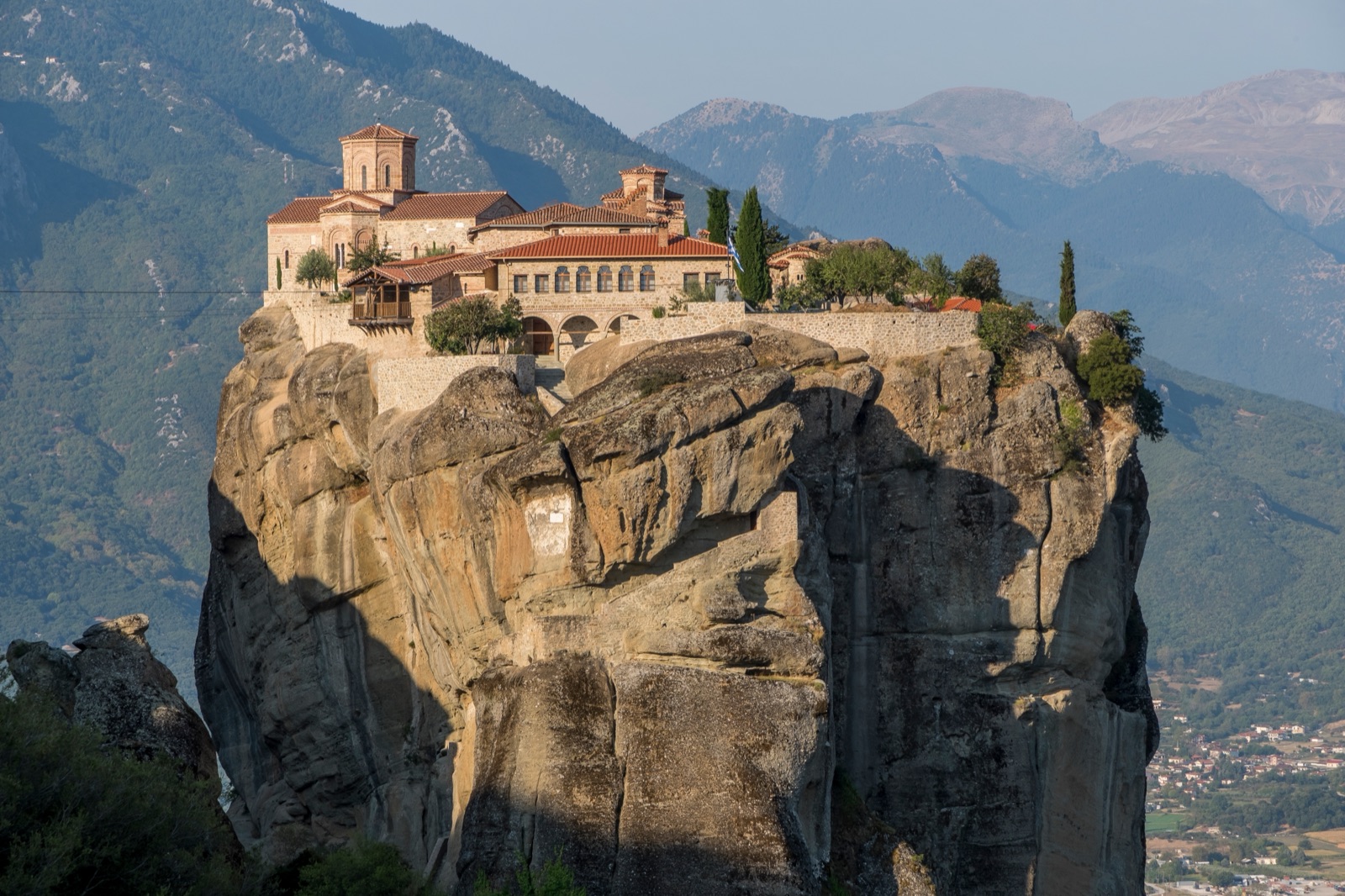
Holy Trinity (Agia Triada in Greek) is the monastery on its own tall pillar at the Kalambaka end of Meteora, and for most of its history it was the hardest of all to reach. Today you walk down a paved path to the foot of the rock and climb between 140 and 149 steps cut into it, depending on who is counting; before 1925, when that stairway was made, monks and visitors went up by rope ladder or were hauled up in a net. The cable car you may see strung across the gorge was added in the 1970s, mainly to carry heavy goods and building materials, and visitors use the steps.
Holy Trinity is also the monastery that played St Cyril’s, the villain’s hideout, in the 1981 James Bond film For Your Eyes Only, and the monks were far from pleased. This article covers the climb, the monastery’s history and what you see inside, the story of the filming, and the small monastery of St Nicholas Anapafsas at the other end of the rocks.
The short answer
- Where: on the eastern rocks of Meteora above Kalambaka, at an altitude of 535 metres, with St Stephen very close by.
- Getting up: a paved path down to the base of the rock, then 149 rock-cut steps by the diocese’s count. The stairway was cut in 1925; before that it was a net or rope ladders.
- The cable car: added in the 1970s, mainly for heavy objects and materials.
- History: named as an organised monastery in a decree of 1362; its church dates from 1475/6, with wall paintings of 1692 and 1741.
- James Bond: the exterior stood in for St Cyril’s in For Your Eyes Only (1981). The monks objected and tried to spoil the shoot.
- Visiting: closed on Thursdays. Allow about 45 minutes, and go in the morning if you can.
Where Holy Trinity is
The Meteora-Pyli Geopark places Holy Trinity on the eastern rocks of Meteora, above Kalambaka, with the monastery of St Stephen very close by to the east. The Holy Metropolis of Stagoi and Meteora, the local diocese, describes it rising on a giant rock at an altitude of 535 metres. A local tour operator’s guide puts it about a 10-minute walk from St Stephen.
The geopark counts it among the oldest monasteries at Meteora and says it was the hardest to reach. The reward for the effort is the view: Visit Greece says Holy Trinity offers unparalleled views of all the monasteries of Meteora.
How you get up: path, steps and a cable car
The path and the steps
According to the diocese, a paved path laid out in 2005 leads down from the road to the base of the rock. From there you climb 149 rock-cut steps to the summit and the entrance. Remember that the downhill path becomes an uphill one on the way back.
The step count depends on who is counting. Visit Greece also gives 149. The culture ministry’s page says 145, the geopark says 140 steps were cut in 1925, and a local tour operator’s guide describes a short hike and a stair climb of about 140 steps. In practice it is a steep ten or fifteen minutes either way.
Before the steps: nets and ladders
Until 1925, the geopark says, the only ways up were the net or the rope ladder. The diocese adds detail: the ascent was by alternating rope ladders or by the net of the winch on the balcony, a device the monks cranked to haul people and goods up the cliff.
There were earlier improvements. In 1866 a hieromonk named Anthimos Pelorios built a guest house with three arches, and in 1868 he had a passage cut up through the middle of the rock to make the climb easier. The rock-cut stairway itself was the work of the monk Iakovos Stamatis, who wanted to make the monasteries accessible. The diocese says he began with Varlaam in 1921, continued at Holy Trinity in 1925 and finished at St Nicholas Anapafsas in 1934. Holy Trinity was his own monastery, where he had first become a monk and where he returned when illness ended his time as abbot of Varlaam.
The cable car
The geopark says a cable-car line was added in the 1970s, mainly to carry heavy objects and materials for the needs and upkeep of the monastery. It is the monastery’s supply line across the gorge rather than a lift for visitors, who still use the path and the steps.
When to climb
The operator’s guide warns that the staircase is hard work on summer afternoons in the heat, and says locals usually recommend going before noon. Carry water, wear shoes with some grip, and take your time.
A history in layers
Foundation
The diocese dates Holy Trinity’s foundation to the middle of the fourteenth century. A decree of 1362 issued by Symeon Uroš Palaiologos, the Serbo-Greek ruler of Thessaly, already mentions Holy Trinity as an organised monastery, alongside the Meteoron.
Tradition credits a monk named Dometios with building it in 1438, and the geopark repeats that date. The diocese is more cautious: the story comes from a nineteenth-century abbot of the Great Meteoron who rarely cited evidence, and nothing else is known about Dometios. The culture ministry’s page gives a different year for the same tradition, which shows how uncertain it is. The documents of 1362 are the firmer ground.
The church and its paintings
The katholikon, the main church, is a two-column, cross-in-square church with a dome, built in several phases. According to the culture ministry, its founding inscription dates it to 1475/6. The diocese notes that the sanctuary and main nave are probably the oldest parts.
The spacious narthex was completed in 1689 and painted in 1692. The main church was painted in 1741 by a priest named Antonios and his brother Nikolaos. Beneath those paintings, the diocese says, lies a second, older layer of fine fifteenth-century Byzantine painting.
A small sacristy was added in 1684. To the left of the entrance is the chapel of St John the Baptist, a single small room carved into the rock, built and painted in 1682 at the expense of three hieromonks. The diocese suggests the hollow in the rock may have been a hermit’s cell before it became a chapel.
Hard times and refuge
The Chronicle of Meteora (1527–29) records that Holy Trinity then had no monks at all. Later centuries brought heavy Ottoman taxation and natural disasters, according to the diocese. Yet the monastery also played a part in local resistance, sheltering fighters and, in a notable break with tradition, lifting its ban on women so that refugee and persecuted families could stay.
The twentieth century
The Italian and German occupation brought looting and desecration. The persecution of the monks left the monastery deserted until 1964, when restoration began. In 1979 the old carved iconostasis was stolen, along with its main icons. Since 1980 monks have lived at Holy Trinity without a break.
The monastery’s written heritage survives elsewhere: the culture ministry says 124 manuscripts belong to Holy Trinity and have been kept at St Stephen since 1953.
What you see inside
The culture ministry’s description gives a clear picture of the route. Just inside the entrance, on the left, is the rock-cut chapel of St John the Baptist. A covered corridor then leads on, with the winch tower and the old refectory on the left and a row of vaulted cells on the right. At the end of the corridor is the katholikon.
Behind the church, to the north-west, a path leads to the highest point of the rock. From its balcony you get what the ministry calls a rare view of the other monasteries and the rocks of Meteora. Allow about 45 minutes in all, as the operator’s guide suggests.
Holy Trinity and James Bond
The film
For Your Eyes Only is a 1981 British film directed by John Glen and starring Roger Moore, according to the BFI’s record; it was the twelfth film in the James Bond series produced by Eon Productions. In the film’s climax, Bond and his allies track the villain to St Cyril’s, an abandoned mountaintop monastery, and Bond scales the peak to get in. The operator’s page confirms that the monastery shown as St Cyril’s is Holy Trinity.
Filming moved to Greek locations, including Meteora, in October, a few months before the film’s release.
What the monks thought
Accounts of the production, summarised in the film’s Wikipedia entry, say a Greek bishop was paid to allow filming in the monasteries, but the monks had not been told and were mostly critical. After a case in the Greek Supreme Court, it was decided that the monks owned only the interiors, while the exteriors and the landscape belonged to the local government.
The monks responded by staying shut inside during the shooting and trying to sabotage it as much as they could. They hung their washing out of the windows, covered the principal monastery in plastic bunting and flags to spoil the shots, and put out oil drums to stop the crew landing helicopters.
The film-makers worked around them with back lighting and matte paintings, and by building a similar monastery on a nearby unoccupied rock as well as a monastery set at Pinewood Studios.
The local operator tells a slightly different version: that the producers first had permission from the Greek Ministry of Culture to film inside Holy Trinity, that the monks strongly opposed this, and that only the exterior was filmed, with a set built on a nearby cliff for the indoor scenes. The two accounts differ on who gave permission, but match on the essentials: the monks objected, the inside stayed off limits, and a stand-in monastery was built nearby.
Behind the climb
Roger Moore said he had a great fear of heights and needed to steady his nerves for the climbing scenes in Greece. The shot of Bond falling off the side of the cliff was performed by a stuntman.
The legacy
The operator’s page credits the film with bringing global fame to Meteora for the first time, and bills Holy Trinity as a James Bond legacy. It is worth remembering, when you climb the steps, that the monks who lived there at the time did not want that role. Dress and behave as you would at any other monastery: this is a working community, not a film set.
St Nicholas Anapafsas, at the other end of the rocks
St Nicholas Anapafsas is not near Holy Trinity: it is at the opposite, Kastraki end of Meteora. The diocese describes it as the first monastery you meet as you leave Kastraki for the monasteries, very close to the village. It is often skipped, which is a pity, because it holds some of the most important paintings at Meteora.
Origins
Nobody knows where the name Anapafsas comes from; the diocese suggests an early founder, or the Greek verb for “to rest”. The first monks probably climbed the rock early in the fourteenth century, and remains of wall paintings in the small chapel of St Anthony date to 1350. The monastery was rebuilt early in the sixteenth century, and its main church sits on the second floor.
The frescoes of 1527
A founder’s inscription dated 12 October 1527, above the door into the main church, names the painter as the famous Cretan artist Theophanes Strelitzas Bathas, known as Theophanes the Cretan. Visit Greece describes the murals as his oldest signed work. UNESCO goes further: the frescoes he executed in 1527 became the basic reference for the style and iconography of post-Byzantine painting, one of the reasons Meteora is on the World Heritage List.
Decline and recovery
The diocese records five monks in 1888 and none at all by the early twentieth century, when the monastery began to fall into ruin. A hanging wooden ladder with 62 rungs was once part of the way up; only a small section survives. The first rock-cut stairway came in 1934. During the Occupation (1941-1944) the monastery was hit by mortar fire and seriously damaged. Look for the two rows of wooden balconies hanging off the north-east side.
Hours
The diocese and Visit Greece both list St Nicholas as closed on Fridays, open 09:00 to 17:00 in summer. In winter Visit Greece gives 09:00 to 16:00, while the diocese shows shorter weekend hours of 09:30 to 14:00. Some other listings show no closing day at all, so check before you go.
Visiting Holy Trinity: practical notes
Hours
The diocese and Visit Greece list Holy Trinity as closed on Thursdays, open 09:00 to 16:00 from 1 April to 31 October and 10:00 to 16:00 from 1 November to 30 April. Other listings give a 10:00 opening in summer too, so if you want to be sure of getting in, arrive after 10:00. Entry is €5 per person.
Pairing it with St Stephen
St Stephen is the natural partner, a short walk away and the easiest monastery at Meteora to enter. It is closed on Mondays and shuts for a break in the middle of the day; our article on Roussanou and St Stephen has the details. A good morning is Holy Trinity at opening, before the heat and the crowds, then St Stephen before its midday closure.
Walking up from Kalambaka
The operator’s guide points out that the old trail once used by the monks starts at the base of Holy Trinity’s cliff and leads down to Kalambaka. Walked uphill, it is a stiff climb; our sunset and hiking guide gives the distance and height gain.
Dress and tours
Visit Greece asks for tops that cover the shoulders, long trousers for men and long skirts for women. If you would rather let someone else handle the timetable, the local sunset tour visits viewpoints over all the monasteries, Holy Trinity included, and the morning tour goes inside three monasteries. The tours page lists both.
Frequently asked questions
How many steps are there to Holy Trinity monastery?
The diocese and Visit Greece count 149 rock-cut steps, after a paved path down to the base of the rock. Other sources give 140 or 145. The stairway was cut in 1925.
Is there a cable car to Holy Trinity?
There is a cable car, added in the 1970s, but the geopark says it is mainly for heavy objects and materials. Visitors walk and climb the steps.
Which James Bond film was shot at Meteora?
For Your Eyes Only (1981), directed by John Glen and starring Roger Moore. Holy Trinity’s exterior played St Cyril’s, the abandoned mountaintop monastery Bond climbs to in the film’s climax.
Did the monks allow the filming?
No. Accounts of the production say the monks were not consulted and protested by hanging out their washing, putting up plastic bunting and flags, and blocking helicopter landings. Only the exterior was filmed, and a replica monastery was built on a nearby rock.
Is Holy Trinity open every day?
No. It is closed on Thursdays. The diocese and Visit Greece list 09:00 to 16:00 in summer and 10:00 to 16:00 in winter, but some listings show a 10:00 opening all year, so check before you go.
Is St Nicholas Anapafsas near Holy Trinity?
No. St Nicholas is the first monastery above Kastraki, at the other end of the rocks, while Holy Trinity is above Kalambaka. St Nicholas pairs better with Roussanou; Holy Trinity pairs with St Stephen.