History
Roussanou Monastery and St Stephen: The Two Nunneries of Meteora
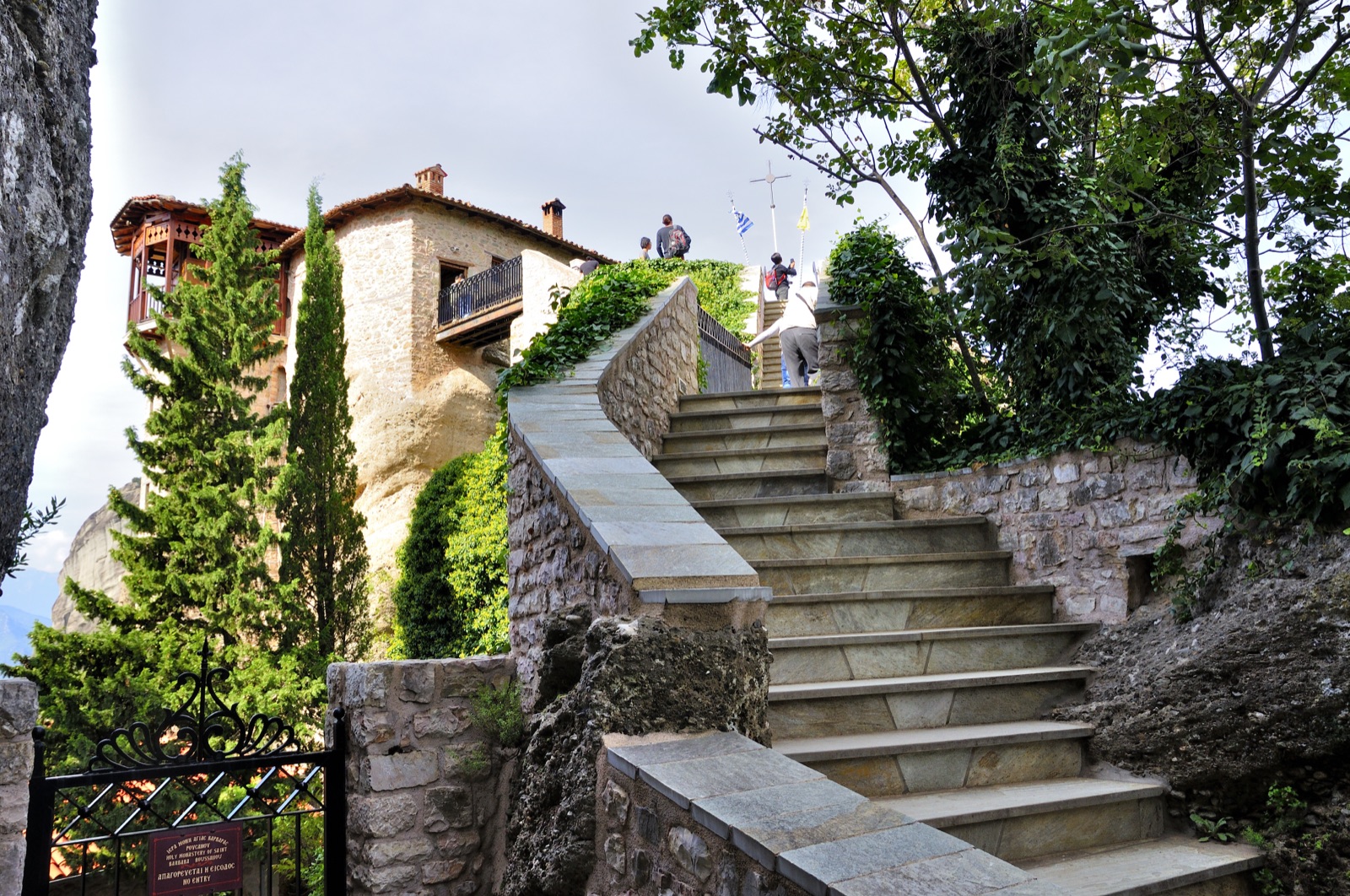
Roussanou and St Stephen are the two Meteora monasteries run by nuns. St Stephen became a women’s monastery in 1961, and Roussanou followed in 1988. Roussanou sits on a narrow, sheer rock beside the Meteora road and is reached by steps and bridges. St Stephen, at the Kalambaka end of the rocks, is reached by a small bridge from the road, with no long staircase at all, which makes it the easiest of the six to visit.
They make a good pair for a first visit: two very different settings, two sisterhoods that rebuilt near-derelict monasteries, and some of the finest painting at Meteora. This article covers the history of each, what you see inside, what happened to them in the Second World War, and how to fit them around their closing days.
The short answer
- Roussanou (also Rousanou, or St Barbara): built on a vertical rock about 60 metres high, at 484 metres above sea level. Its founders, two brothers from Ioannina, settled there between 1527 and 1529. The church frescoes date from 1560. Nuns since 1988. Closed on Wednesdays.
- St Stephen (Agios Stefanos): a hermit lived on the rock in the twelfth century. The old church of St Stephen was rebuilt in 1545, and the main church of St Charalambos was built in 1798. Nuns since 1961. Closed on Mondays, with a midday break.
- The war years: the diocese records that Roussanou, then deserted, was looted during the Occupation (1941–1944), and that St Stephen’s two churches and the whole monastery were badly damaged in the Second World War.
- Access: Roussanou involves steps and a short bridge; St Stephen needs only a walk across a bridge from the road.
Roussanou: a monastery that fills its rock
The Holy Metropolis of Stagoi and Meteora, the local diocese, describes Roussanou as built on a vertical rock about sixty metres high, at an altitude of 484 metres. Its buildings cover the whole summit platform, about 500 square metres, so that, as Visit Greece puts it, the monastery looks like a natural extension of the rock.
Because there is no spare ground, the monastery grew upwards. The culture ministry describes a three-storey complex: the church and cells on the ground floor, and guest rooms, more cells and service rooms on the other two floors.
It stands beside the western road from Kalambaka and Kastraki to the monasteries, between St Nicholas Anapafsas and Varlaam. Varlaam faces it to the north, with the Great Meteoron behind, while Holy Trinity and St Stephen lie to the south-east.
Where the name comes from
Nobody knows. The diocese says the name Roussanou may come from the first person to live on the rock, or from whoever built its first church in the thirteenth or fourteenth century. The earliest written mention is in the so-called Chronicle of Meteora, written shortly after August 1529, which speaks of “the monastery of Roussanou” and says it had been deserted until a few years earlier.
The second name, St Barbara, is probably later. The diocese suggests it dates from 1744/45, when part of the saint’s skull came into the monastery’s possession.
The founders and the frescoes
Visit Greece and the diocese name the founders as two brothers from Epirus, the monks Ioasaph and Maximos from Ioannina. Between 1527 and 1529 they asked for, and received, permission to settle on the rock.
They rebuilt the ruined main church, dedicated to the Transfiguration, from its foundations, added cells and other rooms, and gave the monastery land, vineyards, mills and animals to live on. They organised it as a strict community, and in 1545 they wrote a testament setting out its rules. The Orthodox Church honours them as saints on 7 August, the day after the feast of the Transfiguration.
A small church, richly painted
The katholikon is small: a domed, cross-shaped church of 12.2 by 5.4 metres, with its sanctuary turned to the north-east because the rock left no room to face it due east. The culture ministry describes it as an Athonite-type church with a narthex almost square in plan.
According to an inscription over the entrance, the painting was finished in November 1560, a full thirty years after the monastery was built, under the abbot Arsenios. The inscription does not name the painter. The diocese thinks it was most probably the Cretan painter Tzortzis (or Zorzis), a pupil of Theophanes the Cretan, and the culture ministry calls the work one of the most mature painted ensembles of the Cretan School at its height.
In the narthex, the Last Judgement fills one wall and the other three walls carry thirty-six scenes of martyrdom, arranged in bands. It is a small space, and the effect of so many figures close up is striking.
Icons and the chapel of St Barbara
Display cases outside the church hold some of the monastery’s old icons. The oldest, Christ enthroned, is in the Cretan style, possibly by Theophanes the Cretan himself, and dates from the sixteenth century. North of the church is the small chapel of St Barbara, whose feast on 4 December is celebrated with particular ceremony.
Decline, refuge and the bridges
After a prosperous sixteenth and early seventeenth century, Roussanou declined. The diocese describes poverty and too few monks through the eighteenth century, and nineteenth-century travellers who found only a handful of very old monks, or none at all. The culture ministry notes that it ended up as a hermitage for monks from Varlaam.
It remained a refuge in hard times. During the Greek–Turkish war of 1897, many people from the Trikala area sheltered there.
From rope ladder to bridges
The ministry says the first way up was a rope ladder. A wooden bridge was built in 1868. In 1930, with a donation from Dafno Bouka of Kastraki, steps and two small iron bridges were built to the entrance, replacing wooden ones that had become unsafe. The main approach you use today, from the north-west side, was laid out in the 1990s. On the way up the steps you pass a small rock where, the diocese believes, the founders most probably built the original monastery, known as Old Roussanou.
The war and the nuns
Accounts of Roussanou in the war sometimes speak of bomb damage, but the diocese’s own history is about emptiness and theft. During the Occupation (1941–1944), the monastery, deserted and abandoned, was looted of heirlooms and precious manuscripts, as were other Meteora monasteries.
Its recovery began with two women from Kastraki, Kassiani Dimitriadou and Kyriaki Bouka, who settled there in 1950. After Kassiani’s death Kyriaki lived on alone, repairing the buildings and welcoming visitors, and she took monastic vows shortly before she died. The culture ministry adds that the Archaeological Service restored the monastery in the 1980s.
On 17 October 1988, following the example of St Stephen, Roussanou became a women’s monastery. An eight-member sisterhood came from the Monastery of the Dormition at Stagiades and began rebuilding the half-ruined buildings. In October 1996 the foundations were laid for a new three-storey wing, where the nuns work at icon painting, the sewing of church vestments and gold embroidery.
St Stephen: the monastery you reach by bridge
St Stephen stands at the south-eastern end of the rocks, directly above Kalambaka; from its courtyard the town lies at the foot of the rock, with the Pineios river beyond. Visit Greece notes that a stone bridge connects it to the road, which makes it easy to reach and popular with visitors. The culture ministry calls it one of the most accessible monasteries, as there are no endless stairs to climb.
A long history on the rock
Visit Greece says the ascetic Jeremiah is believed to have lived on the rock in the twelfth century, and the Meteora-Pyli Geopark dates the earliest evidence of the monastery to around 1191–1192. Two monks are honoured as founders: St Anthony Kantakouzenos, of the late fourteenth or early fifteenth century, and St Philotheos, of the mid-sixteenth century.
The first church, dedicated to St Stephen, is a single-aisled basilica built around 1350 and rebuilt in 1545 by St Philotheos.
St Charalambos and the newer church
The monastery’s second patron is St Charalambos. The diocese says his skull was given to the monastery in the fifteenth century by Dragomir, a ruler of Wallachia, and it is still kept there as a relic regarded as miraculous. In 1798 a large new church was built in his honour in the Athonite style; it is now the main church. Its carved wooden iconostasis of 1814 is the work of craftsmen from Metsovo.
The monastery’s treasures are shown in the Old Refectory, a fourteenth-century building with an unusual roof, which serves as a sacristy and museum. Visit Greece mentions manuscripts, early printed books and other precious objects.
War damage and the sisterhood
During the Second World War, the diocese records, both churches and the whole monastery suffered heavy destruction. In 1961 it became a women’s monastery. The diocese describes the first sisters organising it as a community and restoring the buildings as far as possible, in very harsh conditions.
The Meteora-Pyli Geopark describes a large and active sisterhood known for its charitable work as well as for rebuilding. The diocese puts the community at about thirty nuns today, and it also runs a publishing programme on the history and faith of Meteora.
Visiting Roussanou
Hours
The Holy Metropolis and Visit Greece give the same timetable for Roussanou. It is closed on Wednesdays; from 16 May to 31 October it opens from 09:00 to 16:30, and from 1 November to 15 May from 10:00 to 14:00.
Other published listings show shorter summer hours and a season that changes on 1 April; our hours and dress code guide follows the diocese. The Wednesday closure is the same everywhere; for the exact hours on your date, check before you go.
The climb
A local tour operator’s guide counts approximately 140 steps and suggests allowing about 45 minutes. From the road, access involves steps and a short bridge. It is one of the most photographed monasteries and popular with organised tours, so it can feel crowded at midday; go early or in the afternoon.
If you are walking, a path climbs to Roussanou from Kastraki. The route and its climb are in our sunset and hiking guide.
Visiting St Stephen
Hours
Visit Greece and the diocese list St Stephen as closed on Mondays. From 1 April to 31 October it opens from 09:00 to 13:30 and from 15:30 to 17:30; from 1 November to 30 April, from 09:00 to 13:00 and from 15:00 to 17:00. Note the midday break, when the gate is shut.
Access and time
A local operator describes St Stephen as the only monastery without stairs, which makes it the natural choice for anyone who finds steps difficult. It suggests allowing 30–45 minutes for the grounds, the church and the views.
Holy Trinity is its near neighbour, and the two are often seen together; see our article on Holy Trinity and the James Bond film.
Which one to choose if you only have time for one
The two nunneries suit different visitors, and it is worth knowing which you are before you set off.
- Choose Roussanou for the painting and the setting. The church is small, but its frescoes of 1560 are among the finest at Meteora, and the narthex with its scenes of martyrdom is unforgettable at close range. The approach, up the steps and over the bridges onto a rock the buildings fill completely, is part of the experience.
- Choose St Stephen if steps are a problem. It is the one monastery you can walk into across a bridge from the road, so it works for anyone with limited mobility, for young children and for older relatives. The larger church of St Charalambos, the carved iconostasis and the museum in the Old Refectory make it more than a consolation prize.
- Choose by the calendar. On a Wednesday, only St Stephen is open of the two; on a Monday, only Roussanou. In winter, St Stephen’s afternoon session keeps it open later than Roussanou.
Photographs and viewpoints
Roussanou is at its most dramatic from outside. The local operator’s guide recommends the nearby panoramic viewpoints, where the monastery sits on its narrow pillar, and points out that a path from the monastery up to the main road leads to a viewpoint where you can walk out onto the bare rock. It also rates Roussanou as one of the best monasteries for photographs around sunset, even though the monastery itself is closed by then.
St Stephen is the opposite: the best pictures are taken from inside, looking out. The same operator recommends it for panoramic views over Kalambaka and the Thessalian plain, and the geopark describes the view from the courtyard, with the town at the foot of the rock and the Pineios river beyond. Inside both churches, follow the signs about photography.
Seeing both in one day
Roussanou is closed on Wednesdays and St Stephen on Mondays, so both are open on Tuesdays, Thursdays, Fridays and at weekends. They sit at different points on the Meteora road, so you need transport or a good walk between them.
A simple plan in summer:
- Morning: Roussanou at opening, before the tour groups.
- Late morning: St Stephen, arriving well before its midday closure.
- Afternoon: St Stephen is open again from 15:30 if you ran late, and Holy Trinity is nearby.
In winter, Roussanou does not open until 10:00, and both monasteries close earlier, so start with whichever you most want to see.
Dress and behaviour
These are the homes of working communities of nuns, and the usual rules apply: in Visit Greece’s words, tops that cover the shoulders, long trousers for men and long skirts for women. Visit Greece notes that monasteries typically provide long skirts and scarves at the entrance, but it is simpler to arrive dressed for the visit. Entry is €5 per person at each monastery. Keep your voice down, and treat the nuns with the courtesy and discretion Visit Greece asks for.
With a guide
If you would rather not plan around the closing days, the local tours pick up in Kalambaka and Kastraki. The sunset tour includes the inside of one monastery, the hermit caves and the sunset viewpoints; the morning tour sees all six from outside and goes inside three. The tours page lists them with live prices.
Frequently asked questions
Is Roussanou a nunnery?
Yes. On 17 October 1988, following the example of St Stephen, Roussanou became a women’s monastery, and an eight-member sisterhood moved in from Stagiades. It had been run by monks before that.
Why is it called Roussanou?
Nobody knows for certain. The diocese suggests the name may come from the rock’s first settler or the builder of its first church. The second name, St Barbara, probably dates from 1744/45, when part of the saint’s skull came to the monastery.
How do you get into Roussanou?
By steps and a short bridge from the road. The first iron bridges and steps were built in 1930, replacing wooden ones, and the present main approach from the north-west dates from the 1990s. A local operator counts approximately 140 steps.
Which Meteora monastery is the easiest to reach?
St Stephen. A stone bridge connects it to the road, and it is the only monastery without a long staircase. It is closed on Mondays and shuts for a break in the middle of the day.
When did St Stephen become a nunnery?
In 1961. The first nuns restored the damaged buildings in very harsh conditions, and about thirty nuns live there today, according to the diocese.
Were the monasteries damaged in the Second World War?
Yes. The diocese records that St Stephen’s two churches and the whole monastery were badly damaged, and that Roussanou, deserted during the Occupation (1941–1944), was looted of heirlooms and manuscripts.