History
Great Meteoron Monastery and Varlaam: History and What to See Inside
The Great Meteoron is the largest of the six working monasteries at Meteora and the first of the big foundations. The monastery’s own history says it was founded in about 1340 by St Athanasios the Meteorite, on the rock he named Meteoron. Varlaam, the second largest, stands on the neighbouring rock just across the gap. Both are communities of monks, both have museums and fine frescoes, both were once reached by net or ladder, and they are close enough to see in a single morning.
The catch is the timetable. Great Meteoron closes on Tuesdays all year, and in winter on Wednesdays and Thursdays as well; Varlaam closes on Fridays, and in winter on Thursdays too. This article covers who built each monastery and when, what you actually see inside, how people got up before the steps were cut, and how to fit both into one visit.
The short answer
- Great Meteoron: founded in about 1340 by St Athanasios on the Platys Lithos, the Broad Rock. The culture ministry calls it the biggest of the Meteora monasteries, and Visit Greece says it stands on the tallest and largest rock.
- Varlaam: named after a fourteenth-century hermit, then refounded by two brothers from Ioannina, Theophanes and Nektarios Apsarades, who settled on the rock in 1517/18. Its church of All Saints dates from 1541/42.
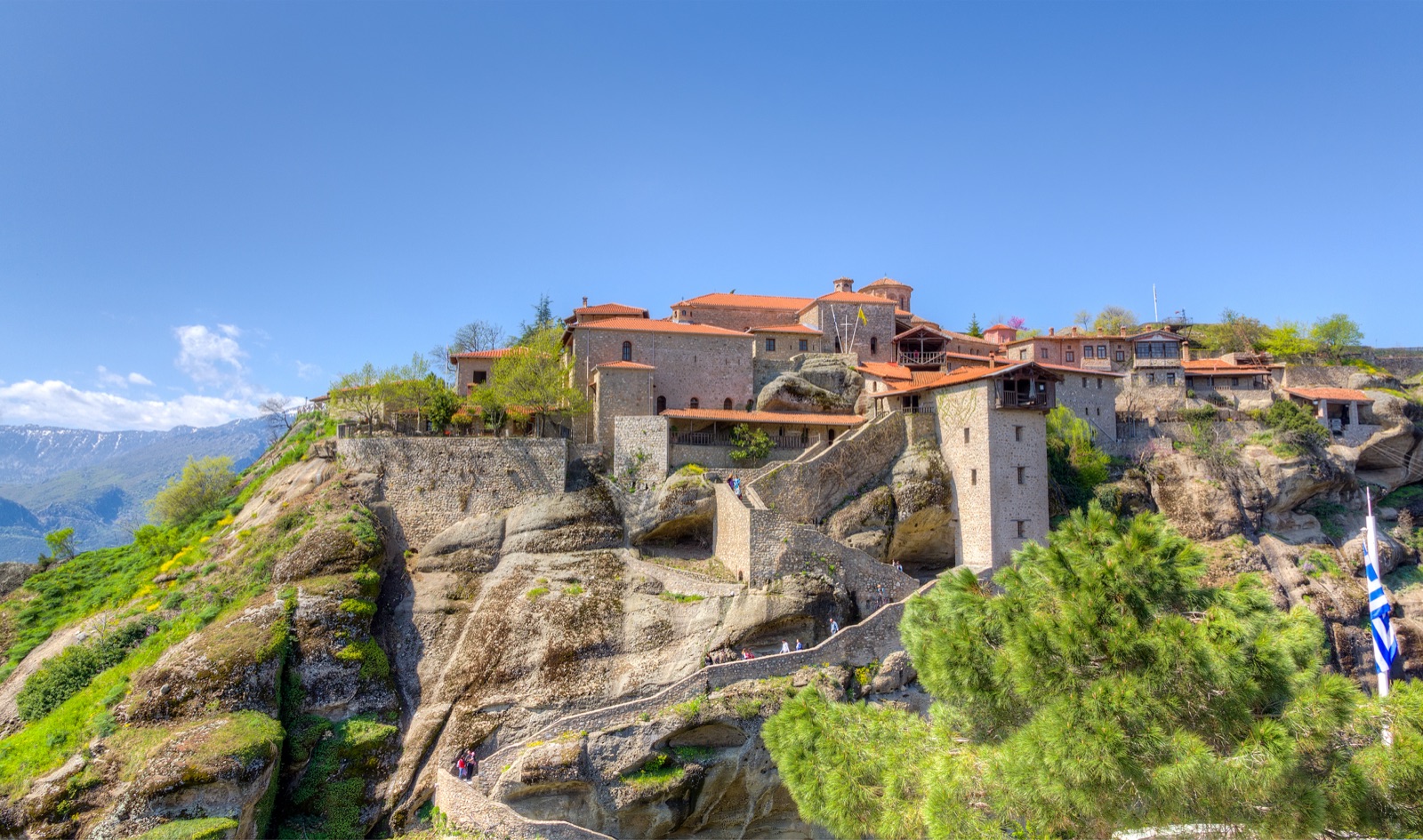
- Inside Great Meteoron: the founder’s cave hermitage, a church painted by the Cretan artist Tzortzis, a refectory of 1557, the old kitchen, a museum and the tower where the net was raised.
- Inside Varlaam: frescoes of 1548 attributed to Frangos Katelanos, a narthex painted in 1566, a museum of manuscripts and embroidery, and the cliff up which pilgrims were once hoisted in a net.
- Practicalities: €5 per person at each monastery, a modest dress code, and plenty of steps at both.
Before the monasteries: hermits on the rocks
Monks lived on the Meteora rocks long before there was any large monastery. Great Meteoron’s own history describes the first inhabitants as hermits in cave dwellings reached by rope ladders. They gathered around a small church at the foot of the rocks, the Panagia Doupiani, which still stands near Kastraki.
That loose community of hermits is the background to everything that follows. The big monasteries were an attempt to bring order to it: a fixed rule, a common table and a church big enough for everyone.
How Great Meteoron began
According to the monastery, Athanasios and his elder, Gregory, settled on the Rock of Stagoi in about 1333 or 1337; Visit Greece describes Athanasios as a monk from Mount Athos. A few years later Athanasios moved to the rock known as Platys Lithos, the Broad Rock. Greece’s national tourism site dates the start of organised monastic life at Meteora to 1340, with his arrival there.
He called the rock Meteoro, meaning a rock suspended between heaven and earth, and set up a community on the Athonite model, with a rule he wrote himself. The Holy Metropolis of Stagoi and Meteora, the local diocese, points out that this name came to be used for the whole stone forest. When visitors talk about “Meteora” today, they are borrowing the name of this one monastery.
Athanasios first built a church dedicated to the Panagia Meteoritissa, the Virgin of the Meteoron, and later another main church, or katholikon, in honour of the Transfiguration of Christ. That dedication to the Transfiguration is why Greek sources often call the monastery the Metamorphosis.
Joasaph, the king who became a monk
The monastery’s second founder was a Serbian-Greek prince. At some time between 1372 and 1373, John Uroš Palaiologos, who had succeeded the Serbo-Greek ruler of Thessaly, Symeon, became a monk at the age of twenty-two and took the name Joasaph. Athanasios named him as his successor while still alive.
Joasaph lived on the rock for about fifty years, until his death in 1422/23. In 1387/88 he rebuilt Athanasios’s church as a much grander building, with help from his sister, Maria Angelina Palaiologina, Queen of Ioannina. The culture ministry’s heritage site dates the katholikon of the Transfiguration to the middle of the fourteenth century and to 1387/88, and records painting campaigns in 1483 and 1552.
Having a monk who had been a king made a real difference. Royal money and connections paid for buildings, icons and manuscripts, and the monastery’s museum still holds objects linked to Joasaph’s time.
Symeon and the sixteenth-century church
The monastery’s golden age came in the middle of the sixteenth century, under the abbot Symeon from Ioannina. On his initiative a grand new katholikon was built in 1544. The monastery’s site describes it as a four-columned, cross-in-square church of the Athonite type, with side apses and a spacious columned narthex.
Symeon also created a scriptorium, where manuscripts were copied, and what the sources call the Academy of Socrates. The monastery counts him as its third founder. The church’s wall paintings, still well preserved, are by the Cretan painter Tzortzis, who seems to have been recommended to Symeon by the Metropolitan of Larissa.
Hard centuries
The prosperity did not last. In 1616 Aslan, Pasha of Ioannina, ransacked the Great Meteoron and murdered four of its monks. A few years later a huge fire destroyed a large part of the monastery. Debts and heavy taxes over the following centuries thinned the community, and some neighbouring monasteries were abandoned altogether.
The twentieth century brought new damage. On 18 October 1943 Kalambaka was razed to the ground, and the katholikon of the Great Meteoron was badly damaged. The monastery’s own history says that many vessels, manuscripts and icons were illegally removed in those years and ended up in collections across Europe. In the same period the abaton, the ban on women entering, was abolished, which is why women can visit today.
Things improved from the 1960s onwards, when almost all of the Meteora monasteries were repopulated with new brotherhoods.
What you see inside Great Meteoron
A visit follows a fairly natural route through the buildings on the summit.
The hermitage of St Athanasios
To the left of the entrance is the cave where Athanasios lived. It was converted into a dwelling and a place of prayer, and after renovation it now serves as a chapel. Tradition holds that the monastery’s first church lay inside it.
The katholikon
The church of the Transfiguration is the heart of the monastery. Look for the frescoes by Tzortzis, the carved and gilded iconostasis in its form of 1791, and, in front of it on the right, the fourteenth-century icon of the Panagia Meteoritissa. The tomb of St Athanasios and the relics of the founders are in the narthex. In the gallery on the north side hangs a large wooden semantron, the beam struck to call the monks to prayer.
The refectory and kitchen
The monastery regards its refectory of 1557 as one of the finest of its kind. A row of five drum columns runs down the middle, and the abbot’s monolithic round-edged table survives. Next door is the old kitchen, with a small dome that let the smoke out, and, as Visit Greece notes, its old copper, earthenware and wooden cooking utensils.
The museum
The two-storey infirmary, built in July 1572, now houses the museum of sacred treasures, manuscripts and icons. The oldest Byzantine icons in the collection date from the thirteenth century. The library’s most famous possession is Codex 591, homilies of St John Chrysostom written by the monk Eustathios in 861/2, which the monastery describes as the oldest dated manuscript in Greece. Not every treasure is on show at any one time, so treat the museum as a selection rather than the whole library.
The lift tower and the wine
Visit Greece singles out the lift tower, from which the net that carried the monks was raised and lowered. It also notes the old wooden barrels in the cellar and the vineyard below the cliff, which the brotherhood has been reviving since 2013.
Varlaam: the hermit and the two brothers
Varlaam’s rock stands very close to Great Meteoron, directly opposite it, but its summit is much smaller. According to the Holy Metropolis, tradition says it was first inhabited in the fourteenth century, some six hundred years ago, by a hermit called Varlaam, a contemporary of Athanasios. The monastery still carries his name.
After him the rock was deserted. The real founders were two brothers from Ioannina, the hieromonks Theophanes and Nektarios Apsarades, from an old and wealthy family. Before coming to Varlaam they spent seven years, from 1510/11 to 1517/18, on the narrow pillar of the Forerunner nearby. In their own autobiography they explain that it was too cramped and its air unhealthy, so in 1517/18 they moved to the broader rock of Varlaam, where they found only traces of old buildings and part of a church.
They restored the small chapel of the Three Hierarchs first. As more monks joined them, up to thirty, they decided to build a church big enough for everyone.
A church “in twenty days”
The katholikon of All Saints was built in 1541/42. The brothers wrote that it was raised from its foundations in twenty days, as fast as possible. The Holy Metropolis adds a sensible caution: the building was only roughly finished in 1541/42, and detailed work on the church and narthex went on until May 1544.
Theophanes died on 17 May 1544, just as the church was completed; the Metropolis retells the story of him leaving his cell, leaning on his staff, to see the finished building one last time. Nektarios died on 7 April 1550.
What you see inside Varlaam
The church of All Saints
The main church was painted in 1548. No painter’s name is written on the walls, but Visit Greece and the Holy Metropolis both attribute the work to Frangos Katelanos of Thebes, on grounds of style. In the dome, Christ appears as the righteous judge; on the western piers the two founders appear in their monastic habits, Theophanes holding a model of the church.
The narthex
The narthex was painted in 1566 by two brother painters from Thebes. Its east wall carries the Last Judgement. On the west wall, St Sisoes mourns over the open tomb and skeleton of Alexander the Great, a blunt reminder that power and glory end in the grave.
The chapel of the Three Hierarchs
North of the main church is the small chapel of the Three Hierarchs, built in 1627 and painted in 1637, according to the culture ministry. It replaced the earlier chapel that the hermit Varlaam is said to have built.
The museum
The old refectory is now a sacristy and museum. Visit Greece notes that the monastery’s manuscript collection numbers 290 items, and that from the early sixteenth to the early seventeenth century it ran the best organised copying workshop of all the Meteora monasteries. A gold-embroidered epitaphios of 1609 shows there was an embroidery workshop too. Among the portable icons is a Virgin and Child with angels and saints painted in 1668 by the Cretan painter Emmanuel Tzanes.
Nets, ladders and steps
For centuries, getting up was the hardest part of any visit. UNESCO’s description of Meteora picks out the net in which pilgrims were hoisted vertically alongside the 373-metre cliff where Varlaam dominates the valley. Visit Greece says the first hermits used four rope ladders to reach Varlaam’s summit.
According to the Holy Metropolis, Varlaam’s rock-cut stairway came in 1921, the first of a series organised by the monk Iakovos Stamatis. Holy Trinity followed in 1925 and St Nicholas Anapafsas in 1934; the story of Holy Trinity’s climb is in our article on Holy Trinity and the James Bond film.
Today Visit Greece counts 195 steps up to Varlaam’s plateau, and a local tour operator’s guide puts the climb to Great Meteoron at approximately 300 steps. Step counts vary with where you start counting, but both climbs are steep rather than long, and both are harder work in the midday heat.
Visiting both in one morning
Check the closing days first
Using the hours on the monasteries’ own and the diocese’s sites:
- Great Meteoron: 09:30 to 15:00 in summer, closed Tuesdays; 09:30 to 14:00 in winter, closed Tuesdays, Wednesdays and Thursdays.
- Varlaam: 09:00 to 16:00 in summer, closed Fridays; 09:00 to 15:00 in winter, closed Thursdays and Fridays.
That leaves Mondays, Wednesdays, Thursdays and weekends for seeing both in summer, and only Mondays and weekends in winter.
The start and end of winter differ between sources. Great Meteoron’s own site runs its winter timetable from 1 November to 31 March, while Visit Greece’s page and the Holy Metropolis’s listing for Varlaam run winter hours until 30 April. If you are visiting in April, check which timetable applies. Our full guide to opening hours, fees and the dress code has all six monasteries side by side.
Know the extra closures
Great Meteoron’s own site lists periods when it closes completely: 5–7 August, 30 September and 1 October, and 1–28 February. It adds that the schedule can change by decision of the monastery. UNESCO notes that the monasteries deliberately limit visiting hours to control numbers, so do not expect exceptions at the door.
Order and timing
Start with Great Meteoron. It is the most visited monastery and, as the operator’s guide warns, fills quickly once the tour buses arrive, so aim to be there when it opens. The same guide suggests allowing about 1 hour for it, and many visitors then continue the short way to Varlaam.
Money and clothing
Entry is €5 per person at each monastery; our hours guide covers how to pay. Great Meteoron’s own site says men may not enter in bermudas, shorts or sleeveless shirts, and women may not wear trousers or sleeveless tops. Visit Greece says monasteries typically provide long skirts and scarves at the entrance for visitors who are not dressed for it, but it is simpler to arrive dressed for the visit.
On foot or on a tour
Fit walkers can reach Varlaam on the old paths; the walking section of our sunset and hiking guide lists the short route up from Ypapanti. If you would rather not juggle closing days, a guided morning tour sees all six monasteries from outside and takes you inside three; which three depends on what is open that day. The tours page lists the options, and the getting to Meteora guide covers the train and day trips from Athens.
Frequently asked questions
When was the Great Meteoron monastery founded?
The monastery’s own site says it was founded in about 1340 by St Athanasios the Meteorite. His successor Joasaph rebuilt the church in 1387/88, and the present katholikon dates from 1544.
Which is bigger, Great Meteoron or Varlaam?
Great Meteoron. The culture ministry describes it as the biggest of the Meteora monasteries and Varlaam as the second largest. Varlaam’s rock is close by, but its summit is much smaller.
Can you visit Great Meteoron and Varlaam on the same day?
Yes, and many visitors do. In summer both are open on Mondays, Wednesdays, Thursdays and at weekends; in winter only on Mondays and at weekends. Allow about an hour for each and start early.
How many steps are there?
A local tour operator puts Great Meteoron at approximately 300 steps, and Visit Greece counts 195 steps up to Varlaam. Both climbs are steep rather than long.
What was the net used for?
Before stairways were cut into the rock, monks and pilgrims were hauled up in a net on a rope. UNESCO describes pilgrims being hoisted alongside the 373-metre cliff below Varlaam, and Great Meteoron’s lift tower is still part of the visit.
Is Great Meteoron open on Tuesdays?
No. It is closed on Tuesdays all year, and in winter on Wednesdays and Thursdays too. It also closes completely for set periods in August, at the turn of September and October, and in February, so check before you go.