Meteora by Bus, Car or Plane: Nearest Airports, KTEL Buses and Driving Routes
There is no airport at Meteora. The closest large airport is Thessaloniki airport, about 238 km from Kalambaka, and most international visitors fly into Athens airport, about 350 km away. Smaller options are Ioannina, with domestic flights from Athens, and Volos–Nea Anchialos, which has mostly seasonal flights and is about 2 hours’ drive from Meteora. From any of them you continue by train, KTEL bus (almost always changing at Trikala), hire car or an organised day trip.
This guide covers each airport, the intercity buses, the driving routes and distances, car hire and taxis, and which option suits which trip. For the train from Athens in detail, see our guide to getting to Meteora.
Where Meteora is
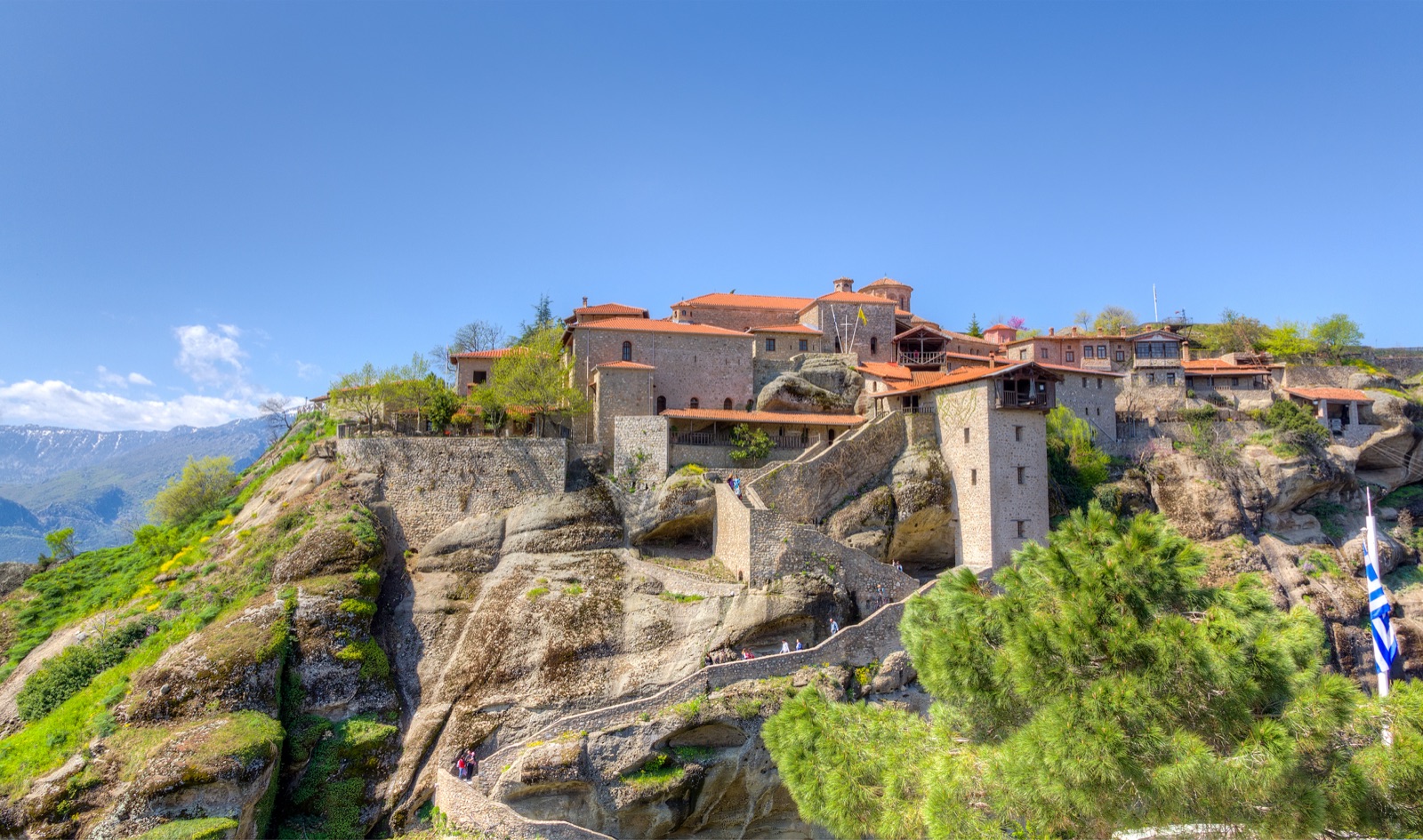
Meteora rises above Kalambaka and the village of Kastraki, in the Trikala area of Thessaly, in the middle of mainland Greece. Kalambaka is the town you travel to: it has the railway station, the bus stop and most of the hotels, and it is about 6 km from the monasteries by road. Trikala, the regional capital, is 21 km away, about 15 minutes by car, and it is the hub for buses.
Nearest airports
| Airport | Distance to Kalambaka | Flights | Onward |
|---|---|---|---|
| Thessaloniki (SKG) | 238 km | Main airport of northern Greece | Bus via Trikala, train, car |
| Athens | 350 km | Main international gateway | Train, bus via Trikala, car |
| Volos–Nea Anchialos (VOL) | About 2 hours’ drive | Mostly seasonal | Bus via Trikala, car |
| Ioannina (IOA) | Bus about 2 hours | Domestic flights from Athens | Bus, car |
These are distances from the airports, as a local tour operator gives them. The driving distances below are from the cities and come from another source, so they differ slightly.
Thessaloniki
Thessaloniki airport is the main airport of northern Greece and the third-largest in the country, 13 km south-east of the city. Greeka calls it the closest airport to Meteora that receives flights from all over the world. From Thessaloniki:
- By car: about 230 km, either via Katerini, Larissa and Trikala, or via Veria, Kozani and Grevena.
- By bus: the municipality lists 6 buses a day from Thessaloniki, taking about 4 hours.
- By train: 2 trains a day, taking 2 hours 54 minutes, according to the municipality’s page.
- By tour: a day trip from Thessaloniki of 11 hours visits two of the six monasteries, with a lunch stop in Kastraki.
Athens
Athens airport is about 350 km from Kalambaka, and it is the airport most visitors use. From Athens:
- By train: the express 884 leaves Athens at 07:20 and reaches Kalambaka at 11:31; the return 885 leaves Kalambaka at 17:15 and arrives in Athens at 21:25. Some trains are not direct and change at Palaiofarsalos.
- By bus: buses run via Trikala (details below).
- By car: about 360 km, via Lamia, Domokos, Karditsa and Trikala.
- By tour: day trips by bus or by train, each about 14 hours, and a two-day trip with a hotel night.
Volos–Nea Anchialos
The small airport at Nea Anchialos, 24 km south-west of Volos, is the only civilian airport serving Volos, Larissa, Kalambaka, Trikala and Karditsa. Its flights are mostly seasonal: Greeka says it works only in summer and receives few charter flights. It is about 2 hours’ drive from Meteora. By bus, the municipality lists 4 a day from Volos, taking about 3 hours.
Ioannina
Ioannina airport is 4 km from the city centre, west of Meteora across the Pindus. Aegean flies there from Athens, and there are some seasonal charters. The municipality lists 2 buses a day from Ioannina to Kalambaka, taking about 2 hours, and you can drive by the Ioannina–Trikala road or the Egnatia motorway.
By KTEL bus
Greece’s intercity buses are run by regional KTEL companies. For Meteora the company is KTEL Trikala, and its buses reach Kalambaka from most of mainland Greece.
The key rule: change at Trikala
Buses from Athens go via Trikala, where you change for Kalambaka. From Trikala, buses to Kalambaka run almost every hour; the municipality counts 22 a day, taking about 40 minutes (Greeka gives 30 minutes). The same applies from Thessaloniki, Volos and most other towns: the municipality lists buses reaching Kalambaka from Athens, Thessaloniki, Patra, Larissa, Volos, Ioannina, Arta-Preveza and Corfu by way of Trikala.
Frequencies and journey times
| From | Buses a day | Journey time |
|---|---|---|
| Athens | 7 | 5 hours 30 minutes |
| Thessaloniki | 6 | 4 hours |
| Volos | 4 | 3 hours |
| Ioannina | 2 | 2 hours |
| Trikala | 22 | 40 minutes |
These are the municipality’s figures. Greeka gives 5 hours from Athens to Trikala and 3 hours from Thessaloniki to Trikala, plus the onward hop. Timetables change, so check KTEL Trikala’s own site for the day you travel.
From Athens: the Liossion terminal
The Athens bus leaves from the Liossion KTEL station, not the main Kifissos terminal. To get there, Greeka suggests taking the metro to Attiki station, then a bus or taxi; on foot it is about 30 minutes. Allow plenty of time.
Bus or train from Athens?
The train is usually faster and more comfortable: the express takes just over four hours, and the station is in Kalambaka itself, with no change. The bus is the fallback when trains are full, disrupted or do not fit your plans, and it is the better option from places the railway does not serve, such as Ioannina.
Practical tips for KTEL buses
- One company per region. Each Greek prefecture has its own KTEL bus company. Meteora is in the prefecture of Trikala, so look for KTEL Trikala (also written KTEL Trikalon).
- Look for green. KTEL buses are painted olive green, sometimes with white stripes.
- Know your Athens terminal. Athens has two KTEL terminals: Liossion, for the companies north of Athens, which is the one you need, and Kifissos, for the south, mainly the Peloponnese.
- Booking. Some KTEL companies have no online booking, so you may buy your ticket at the station or ask your hotel to help.
From Delphi by bus
There is no direct bus between Delphi and Meteora. A local operator explains the usual chain in the other direction: from Trikala you take the Athens bus as far as Lamia, then KTEL Fthiotidos to Amfissa, then KTEL Fokidas to Delphi. Reverse it to come north. By car the trip is about 3 hours, which is why most people combine the two on a tour or a self-drive trip.
By train from other towns
The train is not only for Athens. The municipality’s tourist information page lists daily trains to Kalambaka from several towns:
| From | Trains a day | Journey time |
|---|---|---|
| Athens | 3 | 4 hours 30 minutes to 5 hours |
| Thessaloniki | 2 | 2 hours 54 minutes |
| Larissa | 5 | 1 hour 30 minutes |
| Trikala | 6 | 14 minutes |
These are the municipality’s times. On the timetable above, the morning express from Athens is quicker, at just over four hours.
Some trains are not direct and change at Palaiofarsalos. Timetables change, so check the rail operator’s site close to your travel date. The best train for a day trip from Athens is the morning express: 07:20 out, 11:31 in Kalambaka, and 17:15 back.
Journey times compared
| From | Train | Bus | Car |
|---|---|---|---|
| Athens | 07:20 to 11:31 on the express | 5 hours 30 minutes (via Trikala) | 360 km |
| Thessaloniki | 2 hours 54 minutes | 4 hours | 230 km |
| Volos | Via Larissa | 3 hours | 140 km |
| Ioannina | No railway | 2 hours | Egnatia or Ioannina–Trikala road |
Bus and train figures are the municipality’s; road distances come from an independent climbing guide.
Once you arrive: from Kalambaka to the monasteries
Getting to Kalambaka is only half the journey. The monasteries are on the rocks above, about 6 km by road.
- Summer bus. Especially in the summer months a bus route passes all the monasteries, with three stops in Kalambaka.
- Taxi. Taxis work in Kalambaka and Kastraki and do point-to-point trips.
- On foot. The old footpaths climb from both villages; the M6 path from Kalambaka’s Byzantine church to Holy Trinity is 2.22 km with 470 m of ascent.
- Local tours. The morning and sunset tours pick up from hotels in Kalambaka and Kastraki.
By car
Driving gives the most freedom, both for the journey and for getting around the monasteries once you arrive.
Distances
- Athens: 360 km, via Lamia, Domokos, Karditsa, Trikala and Kalambaka.
- Thessaloniki: 230 km, by two main routes.
- Igoumenitsa, on the west coast: 150 km, through Ioannina.
- Volos: 140 km, through Larissa and Trikala.
- Trikala: 21 km, about 15 minutes.
From Athens
Take the Athens–Lamia–Thessaloniki highway. At the Lamia junction, follow signs for Karditsa and Trikala. Greeka warns that this section is a single-lane rural road that needs careful driving. Continue through Domokos and Karditsa to Trikala, then follow signs to Kalambaka/Meteora.
From Thessaloniki
Take the highway towards Athens and turn off at Larissa for Trikala, then follow signs to Kalambaka. The alternative is the Egnatia motorway west and the road south through Grevena.
From Ioannina or Igoumenitsa
Use the Egnatia motorway or the Ioannina–Trikala road across the mountains.
Car hire
Greeka notes that you will probably find no car hire in Kalambaka, but many agencies in Trikala, 21 km away. If you want a car only for the monasteries, a taxi or the summer bus may be simpler. Our guide to visiting the monasteries without a tour covers parking at each one.
Driving at the rocks
Once you reach Kalambaka, the road up to the monasteries is a different kind of drive: narrow, winding and busy with coaches in season.
- Parking. Each of the six monasteries has its own small car park, free but quick to fill in peak season; parking then spills down the roadside. There are also free public parking areas along the main road.
- Roussanou has only limited parking nearby.
- Go early. Great Meteoron gets busy quickly, so arriving before the first tour buses is advised, for parking as much as for the queue.
- Sunset. The viewpoints fill up before sunset; at Psaropetra, arrive 30 to 40 minutes ahead, and take care on the road afterwards in the dark.
Taxis
Taxis work in Kalambaka and Kastraki and are the practical way to make short trips: the station to Kastraki, up to the monasteries, or out to Theopetra cave, 4 km from Kalambaka. From the station, most accommodation in Kalambaka is 5 to 15 minutes on foot; for Kastraki, a 5 to 10 minute taxi ride is recommended. Agree the fare before you set off.
Organised trips: no driving at all
If you are based in Athens or Thessaloniki and want the simplest day, an organised trip removes all of the above.
- Day trip from Athens by bus (14 hours): a 9am departure from Athens with stops by the sea, a four-hour guided tour with three monasteries visited inside, the hermit caves and lunch.
- Day trip from Athens by train (14 hours): the train from Athens, then a guided tour of the monasteries and the hermit caves.
- Day trip from Thessaloniki (11 hours): by bus, with two of the six monasteries and a lunch stop in Kastraki.
- Two days from Athens: two guided tours including a sunset tour, and a hotel night.
Compare all of them on our tours page.
Which way to travel
| You are | Best option |
|---|---|
| In Athens for a day trip | The train, or a day tour by bus or train |
| In Athens with two days | The train, with a night in Kalambaka or Kastraki, or the two-day tour |
| Flying into Thessaloniki | Hire car, the train, or the Thessaloniki day trip |
| Arriving from the west coast at Igoumenitsa | Car or bus via Ioannina |
| Touring mainland Greece by car | Drive, and stay at least one night |
| Without a car, when the train does not fit | KTEL bus via Trikala |
Combining Meteora with other places
Meteora sits on several classic routes through mainland Greece.
- Delphi: about 3 hours from Kalambaka.
- Dion and Mount Olympus: about 2 hours each.
- Volos: 140 km by road, through Larissa and Trikala.
- Ioannina and Epirus: about 2 hours by bus across the mountains.
If you are touring, Meteora is worth at least one night: the monasteries are best in the morning and the rocks at sunset, and a single afternoon misses both. Our guide to sunset, hiking and how long to stay explains why.
Arriving: what to know before your first visit
- Check the closing days. Each monastery closes on its own weekday, and every Saturday and Sunday all six are open.
- Bring cash. Admission is €5 per monastery, in cash.
- Dress for it. Shoulders covered; men in long trousers; women in skirts below the knee.
- Plan the season. Summer hours run from 1 April to 31 October at Great Meteoron; winter hours are shorter. See our guide to the best time to visit Meteora.
Frequently asked questions
What is the nearest airport to Meteora?
There is no airport at Meteora. The nearest airports are Volos–Nea Anchialos (mostly seasonal flights, about 2 hours’ drive) and Ioannina (domestic flights from Athens, about 2 hours by bus). The closest major airport is Thessaloniki, about 238 km from Kalambaka.
Should I fly into Athens or Thessaloniki?
Thessaloniki is closer, about 238 km against 350 km from Athens. Athens has far more flights and the direct train. Choose by where else you are going.
Is there a direct bus from Athens to Meteora?
Generally not: buses from Athens go to Trikala, where you change for Kalambaka. Buses from Trikala run almost every hour. The Athens buses leave from the Liossion terminal.
How long is the bus from Thessaloniki to Meteora?
About 4 hours in total, according to the municipality, with 6 buses a day; Greeka gives 3 hours to Trikala, plus the onward bus to Kalambaka.
Can I rent a car in Kalambaka?
Probably not, according to Greeka; there are many car hire agencies in Trikala, 21 km away.
Is there a train from Thessaloniki to Kalambaka?
Yes. The municipality lists 2 trains a day, taking 2 hours 54 minutes. Some trains change at Palaiofarsalos.
How do I get from Kalambaka to the monasteries?
In summer a bus route passes all the monasteries from three stops in Kalambaka. Otherwise take a taxi, walk one of the old footpaths, or join a local tour with hotel pickup. The monasteries are about 6 km from town by road.
How long does it take to drive from Athens to Meteora?
The distance is about 360 km, via Lamia, Karditsa and Trikala. Part of the route is a single-lane rural road that needs careful driving, so allow plenty of time and stops.