Meteora Monasteries Without a Tour: Route, Order, Parking, Bus, Taxis and Viewpoints
Visiting the Meteora monasteries on your own is straightforward. Two roads climb to the monasteries, one from Kastraki and one from Kalambaka as you arrive from Trikala, and they meet on the rocks above, so a single drive takes you past all six. Each monastery has its own small car park, free but quick to fill; in summer a bus runs up from Kalambaka past the monasteries; and taxis do point-to-point hops. Fit walkers can use the old footpaths. What makes or breaks the day is not transport but timing: each monastery closes on its own weekday, so check which are open before you choose your route.
This guide covers the layout of the road, the order in which to visit, how much time each monastery takes, parking, the bus, taxis, walking, the viewpoints, and sample routes.
The layout: two roads and six monasteries
The municipality describes two main routes up: the first from Kastraki and the second from Kalambaka as one comes from Trikala. The monasteries are spread along the road that links them.
- From Kastraki: St Nicholas Anapafsas is the first monastery you meet, very close to the village.
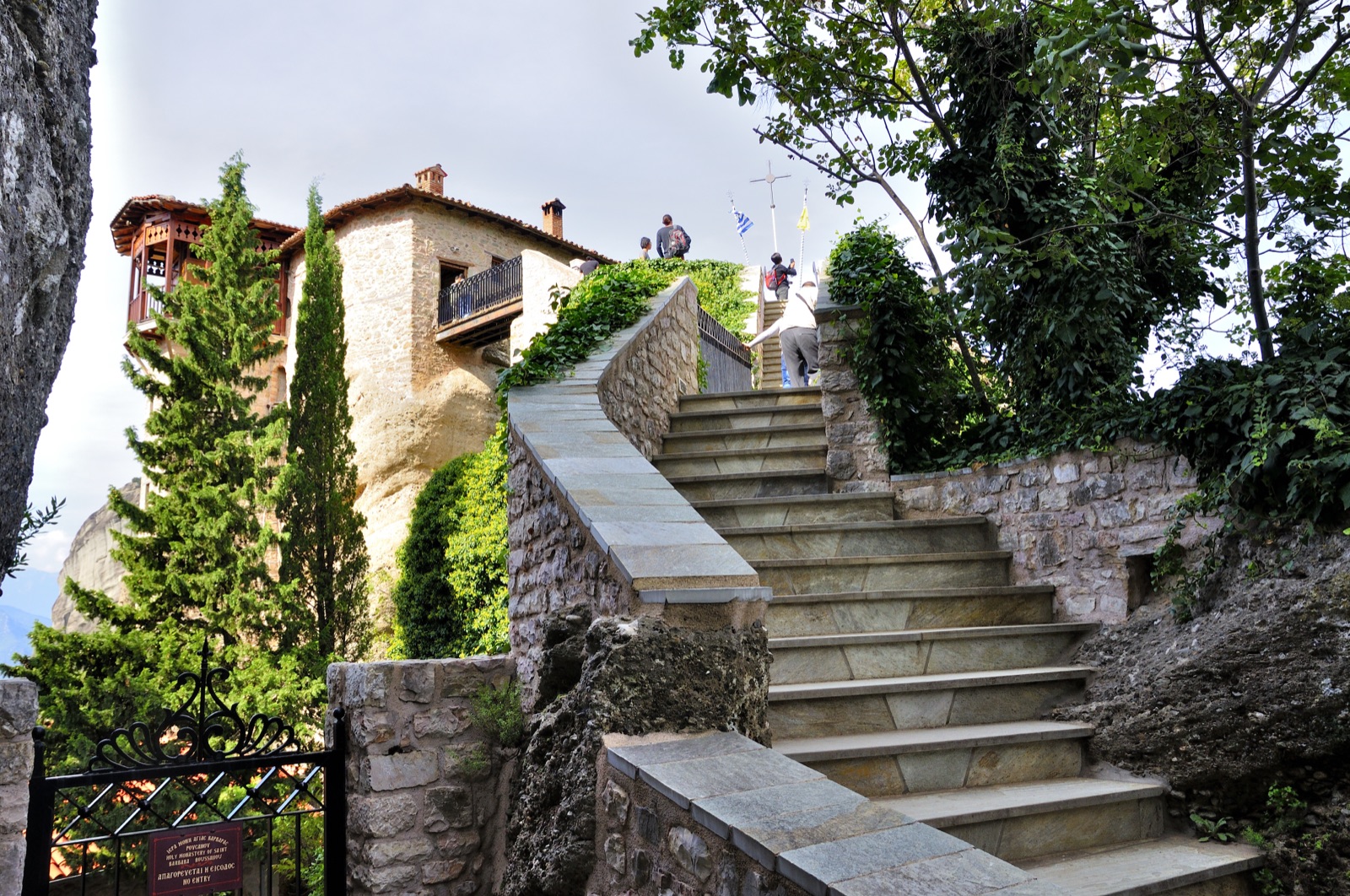
- The middle of the rocks: Roussanou stands on its own cliff beside the road, reached by steps and two small bridges.
- The top of the road: Great Meteoron, on the tallest and largest rock, and Varlaam, on the rock opposite it. They are the two biggest monasteries.
- The eastern rocks, above Kalambaka: Holy Trinity and, very close by to the east, St Stephen. Holy Trinity is about a 10-minute walk from St Stephen.
From St Stephen, the town of Kalambaka lies at the foot of the rock with the Pineios river behind it. From Holy Trinity’s balcony you see the other monasteries and rocks.
The six are, in other words, in two clusters: four on the western and central rocks above Kastraki (St Nicholas, Roussanou, Varlaam, Great Meteoron) and two on the eastern rocks above Kalambaka (Holy Trinity and St Stephen).
The six at a glance
| Monastery | How you get in | Time to allow | Closed (summer) |
|---|---|---|---|
| St Nicholas Anapafsas | Rock-cut stairway (made in 1934) | Not stated | Fridays (Visit Greece; the municipality lists it open daily) |
| Roussanou | Steps and two small bridges, about 140 steps | 45 minutes | Wednesdays |
| Great Meteoron | Long stair, about 300 steps | 1 hour | Tuesdays |
| Varlaam | 195 steps | Not stated | Fridays |
| Holy Trinity | Path down, then 140 to 149 steps | 45 minutes | Thursdays |
| St Stephen | Footbridge, no stairs | 30 to 45 minutes | Mondays |
Times are a local tour operator’s suggestions, where it gives one. Step counts vary by source: for Holy Trinity, the culture ministry gives 145, the Holy Metropolis 149, and the municipality and operator around 140. Hours and closing days for all six, summer and winter, are in our guide to monastery hours, fees and the dress code.
Two notes for planning:
- St Stephen is the easiest. It has no stairs, and the municipality says there is even a lift for disabled visitors.
- Holy Trinity is the hardest. It has around 140 stairs and a rather long path to them. The staircase is hard work on summer afternoons, so locals usually recommend going before noon.
Which order to visit in
There is no single right order, because the closing days change it. But a few principles hold.
- Start at Great Meteoron. It is the biggest, the most visited and the one that gets busy quickly, so arriving early in the morning, before the first tour buses, is advised. It also has the most steps, although Holy Trinity, with its long approach path, is the harder climb.
- Pair Great Meteoron with Varlaam. They face each other at the top of the road, and many visitors combine them in a half-day.
- Do Holy Trinity before noon. For the climb.
- Leave St Stephen for later. It is easy to reach and, because it has a midday break and reopens in the afternoon, it works late in the day.
- Roussanou gets busy at midday. It is one of the most photographed monasteries and popular with organised tours, so go early or later in the afternoon.
A typical full day, on a day when all are open, might be: Great Meteoron at opening, Varlaam, Roussanou, a lunch break in Kastraki, then Holy Trinity and St Stephen in the afternoon, finishing at a viewpoint for sunset. Three or four monasteries inside already make a full day of stairs. On a hot summer day, move Holy Trinity to the morning, before noon, as locals advise.
By car: driving the road and parking
A car gives the most freedom. You can arrive at opening time, skip a monastery that is closed, and stop at the viewpoints.
The road
The road between the rocks is paved, narrow in places and winding, with sharp bends. Drive slowly, watch for coaches on the bends and for people walking on the road near the viewpoints.
Parking
- Each of the six monasteries has its own small car park. An independent guide says they are free but fill up quickly in peak season, and that parking then spills down the roadside, so you may have to walk some way to the entrance.
- Public parking areas. There are also free public parking areas along the main road, which give access to the footpaths.
- Roussanou has only limited parking nearby.
- Arrive early. The car parks at the gates fill fast in peak months, which rewards early arrivals.
Do not stop on a bend or block the road, and be careful getting out on the valley side.
Hiring a car
Greeka notes that you will probably find no car hire in Kalambaka, but there are many agencies in Trikala, about 21 km away. Our guide to Meteora by bus, car or plane covers the drive.
By bus
Especially in the summer months, the municipality says, a bus route passes through all the monasteries, with three stops in Kalambaka where you can board it. Greeka adds that the bus to the monasteries runs only in summer.
What to know:
- It is a summer service. Outside summer, plan on a taxi, a tour or walking.
- Departures are limited. Ask at your hotel or the bus station for the day’s times, and note the last return.
- Combine it with walking. Ride up, then walk between the monasteries that are close together and back down by a footpath, or take a taxi.
By taxi
Taxis wait in Kalambaka and Kastraki and do point-to-point hops: up to a monastery, back down, or between monasteries. A popular pattern is a taxi up to Great Meteoron at opening time, a walk between the monasteries at the top, and a taxi or the bus back down. Agree the fare before you set off, and for the way back arrange a pickup time or ask the driver for a number to call.
On foot: the old paths
The footpaths are older than the road. For centuries they were the only way to the monasteries, and you still see carved steps along them.
The local trail network lists several routes from the villages up to the monasteries:
| Path | From | To | Distance | Ascent |
|---|---|---|---|---|
| M6 | Kalambaka’s Byzantine church | Holy Trinity | 2.22 km | 470 m |
| M8 | Kastraki’s old aqueduct | Roussanou | 1.72 km | 250 m |
| M2 | Ypapanti | Varlaam | 1.36 km | 125 m |
The municipality grades the Holy Trinity and Adrahti footpaths easy, and the Cave, Small Agia and Holy Spirit footpaths moderate. Its advice:
- Spring and autumn are the best seasons for walking.
- In summer, carry plenty of water and avoid walking between 11am and 4pm.
- In winter, avoid areas that are very wet and slippery.
- Wear proper walking shoes, keep to the paths and take your rubbish with you.
Remember that a walk up still ends with each monastery’s own steps. Walking up and taking a taxi or bus down is a good compromise. Our guide to sunset, hiking and how long to stay describes the main trails in more detail.
The viewpoints along the road
Between the monasteries, the road passes several viewpoints. They are free and open at any hour.
- Psaropetra (“Sunset Rock”). A flat-topped boulder on the circuit road with Roussanou directly below and three more monasteries along the ridge. It is the most photographed single viewpoint. There are no railings, and the valley side drops away without a barrier, so take care, especially after dark.
- The saddle above Roussanou. About 1.2 km down the road from the Great Meteoron car park, an unsigned gravel pull-off looks south over five of the six monasteries.
- Holy Trinity’s balcony. Behind the church, the highest point of the rock has a balcony with a rare view of the other monasteries and rocks (inside the monastery, during opening hours).
The light is best in the hour before sunset, when the rocks turn amber, rose and copper for roughly 20 to 30 minutes. In July and August 50 to 100 people can gather at Psaropetra at peak time; arrive 30 to 40 minutes before sunset.
Where to start from
Where you sleep changes how you do the circuit.
- From Kastraki: the village sits right beneath the rocks, and St Nicholas Anapafsas is just above it. Walkers can be on a footpath within minutes, and the M8 path to Roussanou starts at the old aqueduct.
- From Kalambaka: the town is about 6 km from the monasteries by road and about 2 km from Kastraki. The M6 path to Holy Trinity starts at the Byzantine church, and the summer bus boards in town.
- From the station: most accommodation in Kalambaka is 5 to 15 minutes on foot from the station; from Kastraki a 5 to 10 minute taxi ride is recommended.
If you arrive by the morning express from Athens, at 11:31, the early start at Great Meteoron is already gone. A good plan is the eastern monasteries and a sunset viewpoint on the first day, and Great Meteoron at opening time the next morning.
With limited mobility or small children
Most monasteries mean stairs, and the rock-cut steps can be steep and worn.
- St Stephen is the one to choose: reached by a footbridge with no stairs, with a lift for disabled visitors.
- Roussanou is reached by steps and two small bridges from the road, about 140 steps.
- Holy Trinity is the one to skip: a path down to the foot of the rock, then the long stair.
- Viewpoints need no stairs at all, though Psaropetra has no railings, so hold small children’s hands.
The municipality’s advice is that you do not need to see every monastery in one day: there is plenty of accommodation in Kalambaka and Kastraki, so you can spread the stairs over two mornings.
Behaviour and photography inside
The six are living communities, four for men and two for women. Photography is generally allowed outdoors, but inside chapels and some parts of the monasteries it may be restricted, so follow the signs. Do not photograph the monks or nuns, and keep your voice down.
What to bring
- Cash. Admission is €5 per monastery, paid at each entrance, in cash.
- The right clothes. Shoulders covered; men in long trousers; women in skirts below the knee. The municipality says sleeveless clothing and shorts are prohibited; some monasteries lend wrap-skirts, but stock varies and queues form in peak season.
- Water and snacks. There are no cafés or restaurants at the monasteries. There are public toilets.
- Good shoes. Most monasteries involve stairs.
- The timetable. The municipality warns that opening hours change from year to year.
Sample routes by day of the week
Because closing days differ, here are three ways to plan a day (using the summer closing days; check winter days before you go).
A Saturday or Sunday
All six are open. Start at Great Meteoron at opening time, then Varlaam opposite it. Drive or walk down to Roussanou, then lunch in Kastraki. In the afternoon, Holy Trinity and St Stephen, and a viewpoint for sunset.
A Tuesday (Great Meteoron closed)
Start at Varlaam, then Roussanou. After lunch, Holy Trinity (before the heat if possible) and St Stephen. See Great Meteoron from the viewpoints instead.
A Friday (Varlaam closed)
Great Meteoron at opening, then Holy Trinity before noon. Afternoon: Roussanou and St Stephen. The diocese and Visit Greece also list St Nicholas Anapafsas as closed on Fridays.
If you are visiting in winter, remember that Great Meteoron also closes on Wednesdays and Thursdays and Varlaam on Thursdays, so a winter weekend is the easiest time.
On your own or with a tour?
Doing it yourself costs less and gives you the freedom to linger. A tour removes the driving, the parking and the timetable puzzle.
- On your own: best if you have a car or are staying in Kastraki or Kalambaka with time to walk, and if you want to choose your own monasteries.
- The morning tour: all six monasteries seen and three visited inside, with a guide plus audio guides and pickup in Kalambaka or Kastraki, over 4 hours.
- The sunset tour: every monastery seen from the viewpoints, the inside of one, the hermit caves and sunset over the rocks, also 4 hours with pickup.
Many visitors combine the two: monasteries on their own in the morning and a sunset tour in the evening, or the reverse. Compare both on our tours page.
Frequently asked questions
Can you visit the Meteora monasteries without a tour?
Yes. Two roads lead up from Kastraki and Kalambaka, each monastery has a small car park, a bus runs in summer, and taxis are available in both villages. Just check the closing days first.
Is there parking at the Meteora monasteries?
Yes, each has a small free car park, and there are free public parking areas along the main road. They fill quickly in peak season, so arrive early.
Is there a bus to the monasteries?
In summer, yes: a bus route passes all the monasteries, with three stops in Kalambaka. Outside summer, use a taxi, a tour or the footpaths.
Which monastery should I visit first?
Great Meteoron, at opening time, before the tour buses arrive. Then Varlaam, opposite it.
How many monasteries can you visit in a day?
Three or four inside is comfortable. All six is possible only on a day when all are open, usually a weekend, and it makes for a long day of stairs.
Which monastery is easiest to reach?
St Stephen, reached by a footbridge with no stairs; it even has a lift for disabled visitors. Holy Trinity is the hardest.
Are there toilets and cafés at the monasteries?
There are public toilets, but no cafés or restaurants, so bring water and snacks.