Rock Climbing in Meteora: Rules, Best Season, Rock, Routes and Guided Climbs
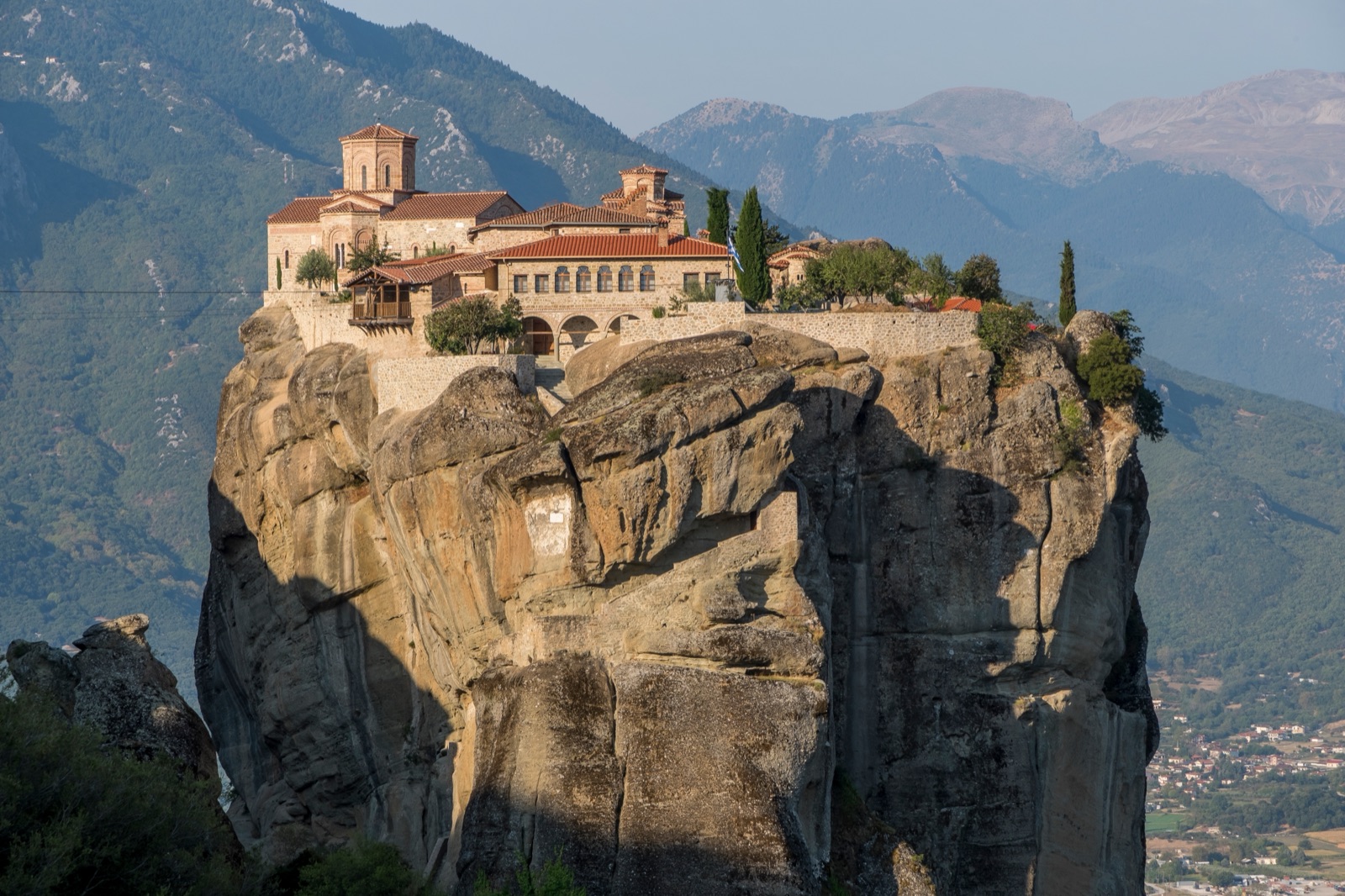
Yes, you can rock climb at Meteora, and it is one of the most unusual climbing destinations in Europe. There are approximately 900 multi-pitch routes on the towers above Kalambaka and Kastraki, on a rock of pebbles and cobbles set in sandstone, and every route ends on the top of a tower. The one firm rule: climbing is forbidden on the six towers with inhabited monasteries, and Greek law protects the whole area as a sacred site. The best seasons are spring and autumn. Beginners can climb or abseil with a local guide; experienced climbers can come independently with their own rack.
This guide covers the rules, the rock and the climbing style, the history of climbing here, when to go, what to bring, how guided climbing works, and how to fit a climbing trip around the monasteries.
Where you can and cannot climb
Meteora is not an ordinary crag. It is a living monastic landscape, and the rules reflect that.
- No climbing on the monastery towers. An independent climbing guide states that climbing is only forbidden on the six towers with inhabited monasteries, and is allowed on the remaining 50 solid towers and 80 smaller ones. A 2014 report by a local mountain guide confirms that climbing on the six towers with active monasteries has been strictly forbidden since the 1970s.
- Respect churches, chapels and ruins. A local tour operator’s code of conduct goes further, saying climbing is strictly prohibited on rocks that have monasteries, churches, chapels or visible ruins. Many towers carry hermitages, small chapels or the remains of them, so the cautious reading is the right one: if a rock has any religious building or ruin on it, do not climb it.
- No camping, no fires. Campfires, camping and bivouacking between the towers are strictly prohibited.
- Behave as you would in a church. Loud talking, music, barbecues, alcohol and free camping are forbidden by law in the area, and visitors are asked not to photograph the monks or nuns.
Why the rules exist
In April 1976 the Archaeological Service and the Orthodox Church gave written permission to climb at Meteora, and climbing has been tolerated ever since on the towers without monasteries. But since 1995 Greek law has declared the whole area a sacred site, unchangeable and inviolable, following a 1990 decision of the Holy Synod of the Church of Greece.
That status has led to pressure on climbing. A report published on 11 August 2014 described a plan by the local archaeological service that would have restricted access to almost three-quarters of the climbable cliffs, and a petition by local climbers against it. Rules can change, so before a trip check the current situation with a local guide or the Kalambaka climbing community, and follow any signs at the base of the rocks.
The rock: conglomerate, not limestone
The towers are made of conglomerate. The independent guide describes it as a mix of pebbles, cobbles and larger stones set in a cement-like sandstone. The municipality’s explanation of how they formed is that a river carried rock, sand and sediment into an ancient lake about twenty-five million years ago, building a delta that was later eroded into separate towers. Meteora today is a “city of rocks” of more than a thousand outcrops.
For a climber, that means:
- The holds are pebbles and the holes they leave. Shallow holes are common where pebbles have come away.
- It feels loose at first. The rock can feel unstable on your first routes, especially on pebbles that point downwards, but the same guide says you gradually learn that it is stable.
- Technique over power. Most routes are balanced and technical rather than athletic: careful footwork, weight on small pebbles, delicate moves.
- Grades follow the angle. The slope and the size of the pebbles set a route’s grade, and high grades are the exception.
The climbing style
The routes are a mixture of slab-based trad and sport climbing. Many were bolted ground-up by the climbers who opened them, so bolts can be further apart than on a modern sport crag, and you may need to add natural protection.
Routes reach up to 300 m long, at all difficulties, and most are multi-pitch. The great attraction is the summit: almost every route tops out on a tower, with the monasteries on the neighbouring rocks and the plain of Thessaly below.
The tallest and best known is Holy Ghost, a monolith of 300 m and the most imposing tower in the area. Its route Pillar of Dreams is 250 metres long at an average grade of 5c+, and was free-soloed in 1994 by the American climber Jane Balister. Most visitors will be happy simply to look at it.
The theCrag route database lists 232 routes in its Meteora area, divided into Northern, Western, Southern and Eastern groups plus outlying crags such as Gavros and Theopetra. It is a useful place to start research, along with the printed climbing guidebooks.
A short history of climbing at Meteora
Climbing here is far older than the sport. The first hermits reached the rocks with scaffolding, nets and ladders, and access to the monasteries was by removable ladders or hoisting ropes until steps were carved into the rock in the 1920s. You can still see Great Meteoron’s lift tower, from which the net was raised and lowered.
Modern climbing began in the 1970s:
- 1975: Dietrich Hasse and Heinz Lothar Stutte made the climbs that mark the start of modern climbing at Meteora. In August 1975 Hasse and Sepp Eichinger visited for the first time and put up the first four routes.
- 1976: the Archaeological Service and the Church gave written permission to climb.
- 1977: Hasse and Stutte published the first climbing guide, listing 83 routes.
- 1985: climbers had established more than 200 routes.
- 1988: the Panhellenic Climbing Meeting began. The three-day event has been held at Meteora since then, with the climbing federation, the municipality and the Kalambaka Climbing Club.
- 1990s: local climbers, among them young climbers from Kastraki, opened many of today’s classic routes, bolting ground-up.
Visit Thessaly, the regional tourism site, sums up the result: since the 1970s Meteora has been one of the most important climbing destinations in Europe, with hundreds of routes for beginners and experienced climbers alike.
Best time to climb
Climbers want cool, dry rock, and Meteora’s seasons are clear.
| Period | Conditions |
|---|---|
| April to mid-June | Best season; lush landscape, but more chance of rain |
| Mid-June to mid-September | Hot; some routes stay in shade for much of the day |
| Mid-September to the end of November | Best season; drier than spring |
| Winter | Harder, but climbing is still possible on sunny days |
These dates come from the independent climbing guide, which says conditions are best from April to mid-June and from mid-September to the end of November. A guiding company gives slightly narrower windows, early May to mid-June and October to mid-November, and Visit Thessaly calls spring and autumn the best times.
In summer, start early and pick shaded faces. The municipality’s advice to walkers, to avoid the heat between 11am and 4pm, applies even more on a sun-baked wall. In winter, watch for wet rock: Visit Greece notes that trails can become slippery, and wet conglomerate is no place for a lead.
For the forecast before a climbing day, see the Meteora weather page. Our guide to the best time to visit Meteora covers the seasons in more detail.
What to bring
The independent guide’s recommended rack for independent climbers:
- Personal gear: harness, shoes, belay and abseil device, carabiners, slings, a lanyard, some nuts and some cams.
- Quickdraws: 10 to 16.
- Ropes: two 60 m half-ropes for the multi-pitch routes, or a 70 to 80 m single rope for sport climbing.
- A helmet. Pebbles do come away, as the holes in the rock show.
Bring water for the whole day. There are no cafés or restaurants at the monasteries or on the circuit road, so carry what you need from Kalambaka, which has a supermarket, or the mini-market in Kastraki.
Climbing with a guide
You do not need to be an experienced climber to try. Visit Thessaly says Meteora suits beginners as well as advanced climbers, with local climbing schools and professional guides providing the equipment, and describes climbing with experienced guides as essential for anyone new to the rock.
What guided climbing usually looks like:
- Taster sessions for beginners on a short route, with all equipment provided.
- Multi-day programmes for climbers with some experience. One mountain-guide company suggests a trip of 4 to 7 days, asks for some indoor or outdoor single-pitch climbing experience, and lists private guiding at €380 per day for one or two people, with an IFMGA/UIAGM mountain guide and group equipment included.
- What is not included: in that company’s case, travel, accommodation, food, personal climbing equipment and mountain rescue insurance.
Check that your travel insurance covers climbing before you go.
Rappelling for non-climbers
If you want the view from a tower without the climb, rappelling (abseiling) is the gentler option. Visit Thessaly describes descents from the rocks with views from the monasteries to the Thessalian plain and the Pindus mountains, combining adrenaline and calm. As with climbing, it is done with a local guide who provides the equipment.
Where to stay for climbing
Kastraki is the climbers’ village. It sits right among the towers, and the independent guide calls it the best base, with small hotels, rental rooms and two campsites. Kalambaka, about 2 km from Kastraki, has more hotels, the railway station and the supermarket.
Kastraki is also the base for walking among the rocks. Our guide to getting to Meteora compares the two villages in more detail.
Getting there with climbing gear
Meteora is in the middle of mainland Greece. Distances by car, from the independent climbing guide:
- From Athens: 360 km, via Lamia, Domokos, Karditsa, Trikala and Kalambaka.
- From Thessaloniki: 230 km, via Larissa and Trikala, or via Kozani and Grevena.
- From Igoumenitsa: 150 km, through Ioannina.
- From Volos: 140 km, through Larissa and Trikala.
The express train from Athens reaches Kalambaka at 11:31 after leaving at 07:20, and buses run via Trikala. A car is useful for reaching the outlying crags, but in Kastraki most towers are a walk from your room. Our guide to Meteora by bus, car or plane covers the options.
Rest days: the monasteries and the rocks from below
Climbing trips need rest days, and Meteora has the best rest-day programme of any crag.
- Visit the monasteries. Admission is €5 per monastery, in cash. Remember the dress code: shoulders covered, men in long trousers, women in skirts below the knee. Climbing clothes will not get you in.
- Check the closing days. Each monastery closes on its own weekday, and every Saturday and Sunday all six are open. See our guide to monastery hours, fees and the dress code.
- Walk the old paths. The footpaths that once linked the monasteries still run between the rocks; the municipality grades the Holy Trinity and Adrahti paths easy.
- Take a tour. The sunset tour visits the hermit caves and ends at a viewpoint; the morning tour visits three monasteries inside with a guide. Both pick up in Kalambaka or Kastraki. Compare them on our tours page.
- Go underground. Theopetra cave, 4 km from Kalambaka, preserves the oldest human footprints found in Greece.
Climbing etiquette at a sacred site
Because Meteora’s climbing depends on goodwill, local climbers ask visitors to be especially careful.
- Keep noise down, particularly near the monasteries and during services.
- Do not leave gear, tape or rubbish at the base of routes. The municipality asks everyone to keep the area clean.
- Stay on the paths on the approach; the operator’s code of conduct asks visitors to keep to designated trails.
- Do not photograph monks or nuns, and do not use a summit as a backdrop for anything that would offend.
- No camping and no fires between the towers.
- Support the local community: the code of conduct encourages buying from local guides, guesthouses and makers.
Safety notes
- The rock is unusual. Spend your first day on easy routes while you learn to trust the pebbles.
- Protection may be spaced. Routes bolted ground-up are bold in places; carry a light rack of nuts and cams.
- Descents are by abseil. Check every anchor, and knot your rope ends.
- Heat is the main hazard in summer. Climb early, choose shade, and carry more water than you think.
- Wet rock is dangerous. Avoid climbing straight after rain.
- Check your insurance. Make sure it covers climbing in Greece, including rescue.
Frequently asked questions
Is rock climbing allowed at Meteora?
Yes, on most towers. Climbing is forbidden on the six towers with inhabited monasteries, and a local code of conduct also rules out rocks with churches, chapels or visible ruins. On the rest, around 50 solid towers and 80 smaller ones, climbing has been permitted since written permission was given in 1976.
How many climbing routes are there at Meteora?
An independent climbing guide puts it at approximately 900 multi-pitch routes. Online databases list only part of them; theCrag shows 232.
What kind of rock is Meteora?
Conglomerate: pebbles, cobbles and larger stones in a cement-like sandstone. The climbing is on the pebbles and the holes left where pebbles have fallen out, and it is more about technique than strength.
When is the best time to climb at Meteora?
April to mid-June and mid-September to the end of November, according to an independent climbing guide. Summer is hot, though some faces are in shade; winter climbing is possible on sunny days.
Can beginners climb at Meteora?
Yes, with a guide. Local climbing schools and guides provide the equipment and choose routes to suit your level, and rappelling is an option if you would rather descend than climb.
Do I need my own gear?
Only if you climb independently: bring 10 to 16 quickdraws and either two 60 m half-ropes or a 70 to 80 m single rope, plus a light trad rack. Guided climbs include group equipment.
Where do climbers stay?
Kastraki, among the towers, with small hotels, rooms and two campsites. Kalambaka, about 2 km away, has more choice and the station.