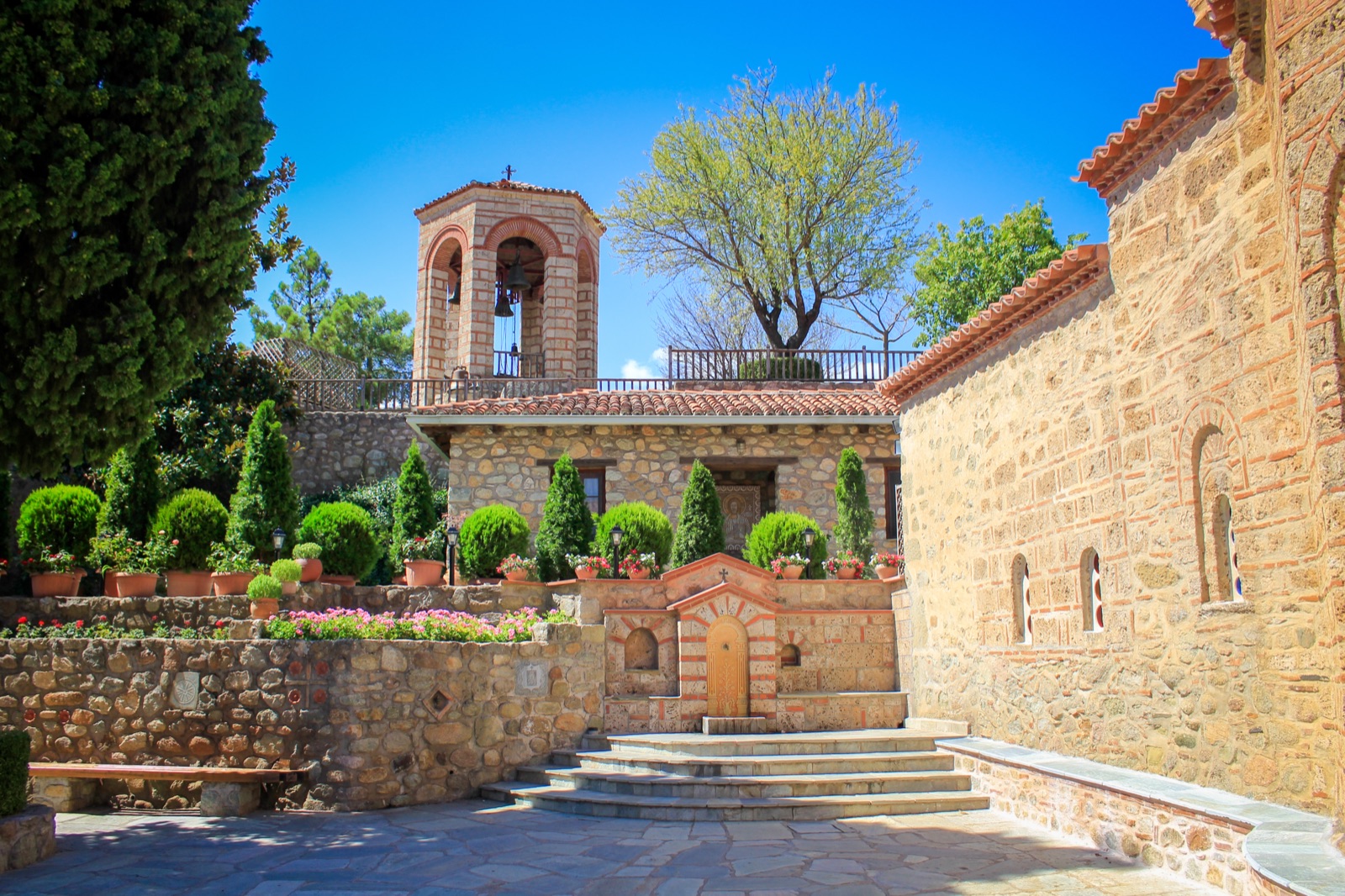
Things to Do Near Meteora: Kalambaka, Kastraki, Theopetra Cave, Trikala and Pyli
There is a lot to do near Meteora once you have seen the monasteries. In Kalambaka itself there is a Byzantine church far older than any monastery on the rocks, a natural history and mushroom museum, and a 3D film centre. Kastraki has a geology museum and the old village lanes. Theopetra cave, 4 km from Kalambaka, holds the oldest human footprints found in Greece. A short drive away are the old town of Trikala and the stone bridge and Byzantine church at Pyli, and beyond them the mountain villages of the Pindus. There is also rafting, truffle hunting with dogs and guided mountain biking.
This guide covers what each place is, when it is open, how long to allow and how to fit it around the monasteries. It is a good list for the middle of the day, when several monasteries close, for a monastery’s closing day, or for a second or third day in the area.
Fitting extra sights around the monasteries
The monasteries shape the day. Each closes on its own weekday, the hours are shorter in winter, and several close in the early afternoon. The best plan for most visitors:
- Morning: monasteries, from opening time.
- Midday: a museum, the Byzantine church or lunch in Kalambaka or Kastraki. There are no cafés or restaurants at the monasteries.
- Late afternoon: a viewpoint or a sunset tour.
- A spare day: Theopetra, Trikala, Pyli or the mountains.
Our guide to monastery hours, fees and the dress code has the full timetable.
Kalambaka: the town below the rocks
Kalambaka is the town at the foot of the rocks, with the railway station and most of the hotels. It looks fairly modern because it was burnt down in 1943 and rebuilt; on 18 October 1943 the town was razed. But it is very old. In Byzantine times it was called Stagoi, and the regional tourism site suggests the modern name may come from the Turkish kale-bak, “strong fortress”.
The Byzantine church of the Dormition
The most important monument in Kalambaka, and one of the oldest in the district, is the church of the Dormition of the Virgin, in the old town at the foot of the rocks.
- What it is: a three-aisled basilica with a wooden roof and three apses, built on the foundations of an early Christian basilica.
- How old: the culture ministry dates its first phase to the late 11th or early 12th century, though later research suggests about 1000. The regional tourism site gives the 10th–11th century.
- What to look for: the tall marble pulpit in the middle of the nave, a rare arrangement. Most of the frescoes were painted in 1573 by the priest Kyriazis and the Cretan monk Neofytos, son of the painter Theophanes, the same Theophanes who painted at St Nicholas Anapafsas in 1527.
It is a church in use, so dress as you would for a monastery: shoulders covered, long trousers or a skirt below the knee.
The old quarter, Sopotos
The old town runs from the town hall to St George’s church, a quarter of narrow cobbled lanes. Here you will find the School of Wood Carving, the only vocational school of its kind in Greece, running since 1949, and one of the few traditional coppersmiths left in the country. A short walk is enough, and it pairs naturally with the Byzantine church.
Natural History Museum of Meteora and Mushroom Museum
A museum that surprises most visitors. It shows about 300 species of animals in dioramas of their natural habitats, and a mushroom collection that is the first of its kind in Greece, showing each species in three stages of growth.
- Where: on the main road towards Trikala, five minutes’ walk from the town centre, with parking.
- Hours: the geopark’s listing gives 10:00–18:00 every day.
- Good for: families, rainy days, the middle of a hot day.
The museum also runs truffle hunts (below) and the Pan-Hellenic Truffle Festival in Kalambaka.
Digital Projection Centre of Meteora’s History and Culture
A municipal centre, opened in May 2017, that shows 3D films about Meteora: its mythology, how the rocks formed, and the monasteries.
- Hours: open 9:00–16:00 every day; shows run every hour from 10:00 to 15:00.
- Booking: shows are by appointment, for a minimum of 4 people.
- Length: 38 minutes in total, in Greek or English.
It is a good introduction before your first monastery visit, especially with children.
Kastraki: the village among the towers
Kastraki sits right beneath the rocks, at the centre of the amphitheatre they form. The municipality calls it the best tourist village of the Trikala area. Its old name is Mesochori, “middle village”. The first monastery you meet going up from Kastraki is St Nicholas Anapafsas.
Museum of Geological Formations of Meteora
If you want to understand the rocks, start here. The museum opened in May 2018 in Kastraki’s old primary school, on the central square.
- Three halls, including a 15-minute video on how Meteora and the Koziakas mountain formed, a hall on geology in Greece, and a detailed explanation of the creation of Meteora.
- Hours: 08:00–15:00 on weekdays, 09:00–16:00 at weekends.
The short version of the story: the most likely explanation is that a river carried rock, sand and sediment into an ancient lake about twenty-five million years ago, building a delta that earthquakes, wind and rain later eroded into the pillars. Meteora today is a “city of rocks” of more than a thousand outcrops.
St George Mandilas and the handkerchiefs
Kastraki’s best-known tradition takes place on the feast of St George. After the liturgy, young men of the village climb the rock by rope to the small 14th-century monastery of Agios Georgios Mandilas, set into the rock, and replace the coloured handkerchiefs that hang there until the next year.
Food, wine and festivals
The municipality recommends tsipouro and local wine, and soutzoukia as the local speciality. Kastraki holds a wine festival at the end of August. Its church of St Nicholas was painted in 1794.
Theopetra cave
Theopetra is the most important sight near Meteora that is not a monastery. It is 4 km from Kalambaka, across from the rocks, in a limestone hill above the village of Theopetra.
Why it matters
- Continuous occupation: the regional tourism site calls it the only known cave in Europe with continuous human presence from the Middle Palaeolithic to the Neolithic, for at least 130,000 years.
- The oldest footprints in Greece: the cave holds the oldest human footprints found in Greece; two belong to children aged 4–5 and date back 130,000 years.
- The oldest wall: a stone wall blocking two-thirds of the cave mouth, dated to 23,000 years ago, is described by the municipality as the oldest built structure in Greece.
- Deep layers: within 500 square metres, excavators found fill layers up to 6 metres deep.
Visiting
| Ticket | €5 full, €3 reduced, including the Documentation and Education Centre |
| Hours | 08:30–15:30 |
| Closed | Tuesdays; also 1 January, 25 March, 1 May, Easter Sunday, 25 and 26 December |
| Last entry | 20 minutes before closing |
| By car | 5 minutes from Theopetra village, 25 minutes from Trikala |
| On foot | 35 minutes from Theopetra village |
The Documentation and Education Centre, in the village, shows finds from the excavations; the same ticket covers both. A taxi from Kalambaka is simple, or combine it with a drive to Trikala.
Note the closing day: Theopetra shuts on Tuesdays, the same day as Great Meteoron, so a Tuesday is not the day to save it for.
Trikala
Trikala, 21 km from Kalambaka, about 15 minutes by car or 40 minutes by bus, is the regional capital and an easy half-day.
- The castle and clock tower. The castle was built by the Emperor Justinian I in the 6th century on the site of the ancient acropolis of Trikki. On its eastern side the Ottomans built a large clock tower in the mid-17th century; the ministry calls the clock towers of Trikala and Larissa the oldest in Greece.
- Varousi. Below the castle, the old Christian quarter of mansions and ten churches from the 16th to the 19th century. A walk through its lanes is the best thing to do in town.
- The river and the “French” bridge. More than 10 bridges cross the Lithaios; the central iron one was built in 1886 by French engineers.
- Asklipiou. The town’s liveliest pedestrian street, south of the river, full of shops and cafés.
- The Koursoum mosque. The Osman Shah mosque is the only work in Greece of the Ottoman architect Mimar Sinan.
- The Tsitsanis Museum. On the life and work of Vasilis Tsitsanis, the great figure of Greek popular music, who came from Trikala.
- The Matsopoulos Mill. The first industrial flour mill in Greece, which worked from 1884 to 1984, is now an arts centre with an industrial museum.
The Mill of the Elves at Christmas
From late November to early January, the mill becomes the Mill of the Elves, the largest Christmas theme park in Greece, about 1.5 km from the centre of Trikala. Admission is free, and it opens daily from 10:00 to 22:00. It is the busiest time to visit Trikala, and a memorable one with children.
Pyli: the stone bridge and Porta Panagia
West of Trikala, where the plain meets the mountains, the Portaikos river leaves its gorge at Pyli, “the gate”. Two of the finest monuments in the region stand here.
The bridge of Pyli
The stone bridge was built in 1514 on the initiative of St Bessarion, Metropolitan of Larissa. It is 65 m long, with a single arch of 29 m span and 13 m high, among the largest single-arch bridges in Greece, and for centuries it was the main crossing from the plain to the mountain villages.
Porta Panagia
On the other bank stands Porta Panagia, the main church of a monastery founded in 1283. Inside are two large mosaic icons of Christ and the Virgin, from 1283–1289, placed on the opposite sides to the usual Orthodox arrangement. A pedestrian bridge 120 m long crosses the river to it. Visiting hours for the church are announced by the local Ephorate of Antiquities.
Allow at least an hour for the bridge and the church. Autumn, when the plane trees turn yellow, is the best time.
Dousiko monastery
About 5 km from Pyli, at 650 m on the slopes of Koziakas, the fortress-like Monastery of St Vissarion of Dousiko was founded in 1535. At its peak it had 365 cells. It is one of the few monasteries outside Mount Athos that women may not enter.
The mountains: Koziakas, Elati and Pertouli
Beyond Pyli the road climbs into the Pindus, to the mountain resorts of Elati and Pertouli.
- Palaiokarya bridge: a stone bridge with two waterfalls beside it, perhaps the most photographed in Greece, a short detour off the mountain road.
- The Koziakas refuge: trails from Elati and Pertouli lead to the refuge, opened in 1959 at 1,750 m; the highest peak, Astrapi (1,901 m), is 30 minutes beyond.
- Aspropotamos: the municipality also suggests the villages of Aspropotamos, where the church of the Holy Cross has 13 domes.
These make a full day out by car and are a good escape from the summer heat in the valley.
Activities around Meteora
Walking the old paths
The footpaths that once linked the monasteries still run between the rocks. The municipality grades the Holy Trinity and Adrahti footpaths easy, and the Cave, Small Agia and Holy Spirit footpaths moderate. Its advice: spring and autumn are the best seasons, and in summer avoid walking between 11am and 4pm. Our guide to sunset, hiking and how long to stay covers the main trails.
Rafting on the Ionas
With the rocks in the background, rafting runs on the Ionas, a side stream of the Pineios, over about 8 km at grade 1 to 2, suitable for all ages. The season is September to June. Local outdoor companies organise it.
Truffle hunting
The Natural History and Mushroom Museum runs truffle hunts with trained dogs, on Sundays for individual visitors. The programme leaves the museum at 10:00, includes a truffle pasta cooked in the forest, a guided visit to the museum and a mushroom tasting, and ends at 13:30.
Mountain biking
Guided mountain-bike rides go through the forest around the rocks to places cars cannot reach. Several companies in Kalambaka hire bikes and lead rides.
Climbing and rappelling
Meteora is one of Europe’s great climbing areas. Beginners can try climbing or rappelling with a local guide who provides the equipment. See our guide to rock climbing at Meteora.
The Koromilia viewpoint
For the most impressive aerial view of Kalambaka, Kastraki and the rocks, the regional tourism site suggests the road to Koromilia, a resort settlement that looks over the area from 1,150 m.
Further afield: Delphi, Dion and Olympus
Meteora is often combined with other sights on a trip through mainland Greece. From Kalambaka, a local operator gives Delphi as about 3 hours away and Dion and Mount Olympus about 2 hours. At that distance Delphi makes more sense as a stop on a longer trip than as a day out from Kalambaka. Our guide to getting to Meteora covers the routes from Athens and Thessaloniki.
A sample three-day stay
- Day one: arrive by the morning train; Byzantine church and old quarter in the afternoon; sunset tour with the hermit caves.
- Day two: monasteries from opening time; lunch in Kastraki; the geology museum; a short walk on the Adrahti path.
- Day three: Theopetra cave in the morning (not on a Tuesday); Trikala’s Varousi and castle for lunch; or Pyli and the bridge in autumn.
The sunset tour and morning tour both pick up in Kalambaka or Kastraki, and the two-day tour from Athens includes a hotel night. Compare them on our tours page.
Frequently asked questions
What is there to do in Kalambaka besides the monasteries?
The Byzantine church of the Dormition with its central marble pulpit, the old quarter and wood-carving school, the Natural History and Mushroom Museum, and the 3D Digital Projection Centre. Theopetra cave is 4 km away.
Is Theopetra cave worth visiting?
Yes, if you are interested in prehistory. It has the oldest human footprints found in Greece, about 130,000 years old, and a record of continuous occupation over at least 130,000 years. Allow an hour or two with the Documentation Centre; it is closed on Tuesdays.
How far is Trikala from Meteora?
About 21 km from Kalambaka, around 15 minutes by car or 40 minutes by bus.
What can you do at Meteora on a rainy day?
The Natural History and Mushroom Museum, the Museum of Geological Formations in Kastraki, the Digital Projection Centre, or the Byzantine church. Trikala’s museums are a short drive away.
What is there to do near Meteora with children?
The mushroom and natural history museum, the 3D films, the geology museum, the gentle rafting on the Ionas and, at Christmas, the Mill of the Elves in Trikala. St Stephen is the easiest monastery with children because it has no stairs.
Can you visit Delphi and Meteora together?
Yes, but not easily in one day. Delphi is about 3 hours from Kalambaka, so the two fit best on a trip of two or more days.